Advertisements
Advertisements
प्रश्न
What is Active transport?
Advertisements
उत्तर
Active transport is the passage of a substance (salt or ion) from its lower to higher concentration through a living cell membrane using energy from the cell. Active transport is in a direction opposite to that of diffusion. Certain nutrients, such as ions of nitrates, sulphates, potassium, zinc, manganese, etc., cannot pass through the cell membrane of the root cells easily. This is because their concentration is higher inside the root cells, and it is so maintained in order to develop osmotic pressure for absorbing water.
APPEARS IN
संबंधित प्रश्न
Lenticels or stomata (Which one remains open always?)
Fill in the blank with the suitable term given below:
Most water gets evaporated from the plant from its __________.
How water absorbed by the roots is important for the plants?
is the following statement true (T) or false (F)? Mark T or F
‘Girdling experiment’ demonstrates food synthesis in plants.
Differentiate between the following
Active transport and Passive transport.
Name the following:
Movement of ions from the region of lower concentration to higher concentration by using energy (ATP).
Active transport involves ______
Which of the following process requires energy?
Identify the CORRECT statement about the active absorption of water.
Three cylinders of potato were carefully dried on blotting paper and weighed. Each piece weighed 3 grams. Each one was placed in the beaker as shown below:
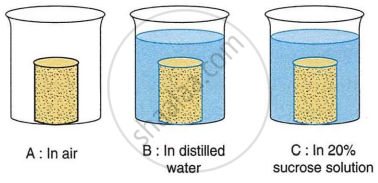
Answer the following questions:
- After 48 hours, which potato cylinder would be the heaviest?
- The movement of which substance is mainly responsible for the weight change in the potato cylinders?
- Name and define the process which is responsible for the movement of the substance mentioned in answer (b).
- Write specific names of the processes which occur in beakers B and C. [kinds of processes defined in answer (c)].
- Would there be any difference in the weight of the potato cylinder in beaker A after 48 hours? Give reason.
