Advertisements
Advertisements
Question
Name the following:
The kind of cells that constitute the cortex of a root.
Advertisements
Solution
Parenchyma
RELATED QUESTIONS
Match the items in column I with those in column II
| Column I | Column II | ||
| (a) | Xylem | (i) | semi - permeable |
| (b) | Phloem | (ii) | permeable |
| (c) | Cell membrane | (iii) | downward flow of sap |
| (d) | Root pressure | (iv) | upward flow of water |
| (e) | Cell wall | (v) | guttation |
What would happen to the root hair of a potted plant if the soil was watered with an extremely concentrated solution of sodium chloride?
Choose the correct answer:
Meaning of ascent of sap is ____________
The diagram below represents a layer of epidermal cells showing a fully grown root hair. Study the diagram and answer the questions that follow:

Mention one distinct difference between the parts labelled A and B.
The alongside diagram A shows a root hair growing through the soil particles. Diagram B is the root hair of an aquatic plant.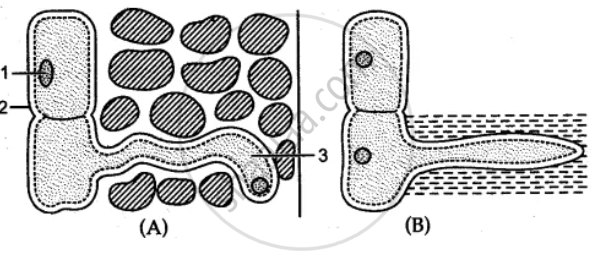
(i) Name the parts 1,2,3.
(ii) Name two substances which enter the root hair. What are their uses?
(iii) By what process do these substances enter the root hair?
(iv) Account for the different shapes of root hairs in the two diagrams.
Draw a diagram of the root hair cell as it would appear when a concentrated solution of fertilizers is added near it.
Draw a neat and labelled diagram of the Root tip showing the root hair zone.
____________ regions are present in a typical root.
Which part of the root helps in maximum absorption of water and minerals?
