Advertisements
Advertisements
Question
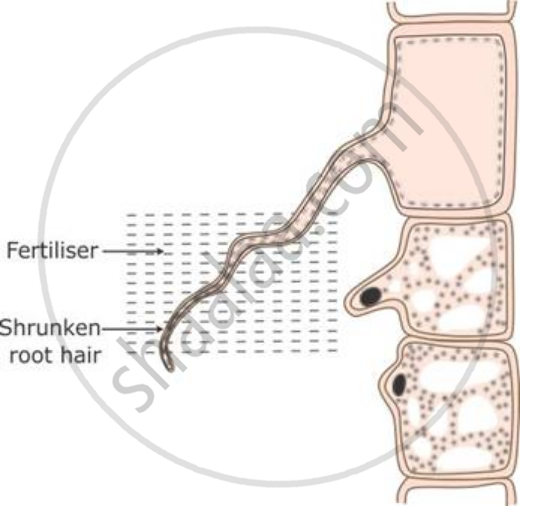
The diagram below represents a layer of epidermal cells showing a fully grown root hair. Study the diagram and answer the questions that follow:

Draw a diagram of the above root hair cell as it would appear when a concentrated solution of fertilizers is added near it.
Advertisements
Solution
RELATED QUESTIONS
The figure given below is a diagrammatic representation of a part of the cross section of the root in the root hair zone. Study the same and then answer the questions that follow

(i) Name the parts indicated by the guidelines 1 to 4.
(ii) Which is the process that enables the passage of water from the soil into the root hair?
(iii) Name the pressure that is responsible for the movement of water in the direction indicated by the arrows. Define it.
(iv) Due to an excess of this pressure sometimes drops of water are found along the leaf margins of some plants especially in the early mornings. What is the phenomenon called?
(v) Draw a well labelled diagram of the root hair cell as it would appear if an excess of fertiliser is added to the soil close to it.
Match the items in column I with those in column II
| Column I | Column II | ||
| (a) | Xylem | (i) | semi - permeable |
| (b) | Phloem | (ii) | permeable |
| (c) | Cell membrane | (iii) | downward flow of sap |
| (d) | Root pressure | (iv) | upward flow of water |
| (e) | Cell wall | (v) | guttation |
Process of ascent of sap in plants occurs by ______.
Choose the correct answer:
Wilting of plants occurs when ____________
Mention whether the following statement is true (T) or false (F) and give an explanation in support of your answer.
If the phloem of a twig is removed keeping the xylem intact, the leaves of a twig wilt.
Mention whether the following statement is true (T) or false (F) and give an explanation in support of your answer.
Guttation in plants occurs maximum at midday.
Multiple Choice Question:
The most widely accepted theory for ascent of sap is ______.
From which type of cells, root hair is originated
Draw a neat and labelled diagram of the Root tip showing the root hair zone.
Which plant does tissue transport water and minerals from the roots to the leaf?
