Advertisements
Advertisements
प्रश्न
The figure given below is a diagrammatic representation of a part of the cross-section of the root in the root hair zone. Study the same and then answer the questions that follow :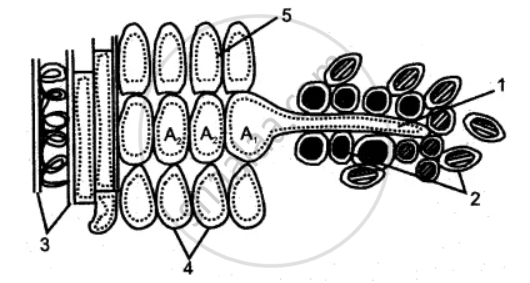
(i) Name the parts indicated by guidelines ‘1’ to ‘5’
(ii) Is the root hair cell unicellular or multi-cellular?
(iii) Draw a labeled diagram of the root hair cell as it would appear if some fertilizer is added to the soil close to it.
(iv) Name the process responsible for the entry of water molecules from the soil into A1 and then A2.
(v) What pressure is responsible for the movement of water in the direction indicated by arrows?
(vi) How is this pressure set up?
Advertisements
उत्तर
(i) 1. Vacuole (containing cell sap)
2. Soil particles
3. Xylem vessel
4. Cortex cells
5. Vacuole in cortical cells
(ii) Root hair cell is unicellular
(iii) See diagram alongside.
(iv) Osmosis
(v) Osmotic pressure
(vi) This pressure is set up due to the difference in osmotic gradient.
संबंधित प्रश्न
State whether the following statement is true or false. Rewrite the false statement correctly.
Water absorption mainly occurs through the root-hair.
Choose the correct answer:
Which tissue makes passage for ascent of sap?
Choose the correct answer:
Absorption of water from soil takes place by __________
Choose the correct answer:
The water is translocated upwards from the roots through _____________
Given below is an experimental demonstration.
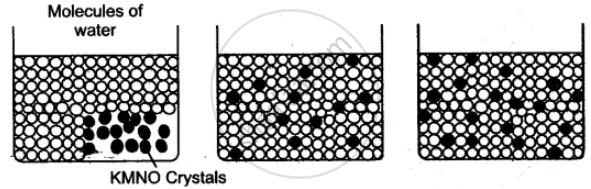
(i) Which phenomenon has been demonstrated in the given figure?
(ii) What is the solute and what is solvent in the above experiment?
(iii) Define the phenomenon in Q. (i) above.
(iv) Give one example from your daily life experiences based on this principle.
Column ‘II’ is a list of items related to ideas in Column ‘I’. Match the term in Column ‘II’ with a suitable idea given in Column ‘I’.
| Column I | Column II |
| (i) Diffusion | (a) The exit or flow of water from the cell to the outer environment. |
| (ii) Xylem | (b) The shrinkage of protoplasm when the cell is kept in a hypertonic solution. |
| (iii) Root pressure | (c) The tissue through which water and mineral salts move upward in a plant. |
| (iv) Isotonic solution | (d) Two solutions which have equal osmotic pressure. |
| (v) Exosmosis | (e) The process by which the molecules of perfume spread in the room when the bottle is open. |
| (vi) Osmosis | (f) The process by which roots absorb water from the soil. |
| (vii) Plasmolysis | (g) The pressure by which water rises up to some feet in a lofty tree. |
| (viii) Hypotonic solution | (h) The concentration of the solution when lower than that of the cell sap. |
Multiple Choice Question:
The most widely accepted theory for ascent of sap is ______.
____________plants like orchids absorb water vapours from air with the help of epiphytic roots having special tissue called velamen.
Explain about the factors that affect water absorption.
