Advertisements
Advertisements
प्रश्न
Mention whether the following statement is true or false. Correct the false statement by altering the last word only.
The cell wall of the root cell is a differentially permeable membrane.
विकल्प
True
False
Advertisements
उत्तर
This statement is false.
Correct statement: The cell wall of the root cell is a fully permeable membrane.
Explanation:
Because cell "membranes" are differentially permeable, and cell walls are fully permeable.
APPEARS IN
संबंधित प्रश्न
Draw a magnified view of the root-hair, and describe, how it helps in the absorption of water from the soil.
The figure shows a diagrammatic representation of the movement of certain substances inside the stem of a certain plant. Write five sentences on whatever you can explain about the processes or the arrangement of structures indicated in the diagram.
Note: - Each sentence must include one or more of the following four words, and each word can be used several times. Xylem, phloem, roots, leaves.

The diagram given below represents the results of an experiment conducted on two freshly taken leafy shoots of a herbaceous plant. The lower ends of the shoots dip in ordinary water.
(i) What is the aim of the experiment?
(ii) Some parts of the stem in both the shoots have been removed. Name the conducting tissue in shoot (a) and in shoot (b) that has been removed.
(iii) What are the results of this experiment?

Choose the correct answer:
Exudation or bleeding is associated with ___________
The diagram given below represents the result of an experiment conducted on two freshly taken shoots of a green herbaceous plant. The lower ends dip in the water.
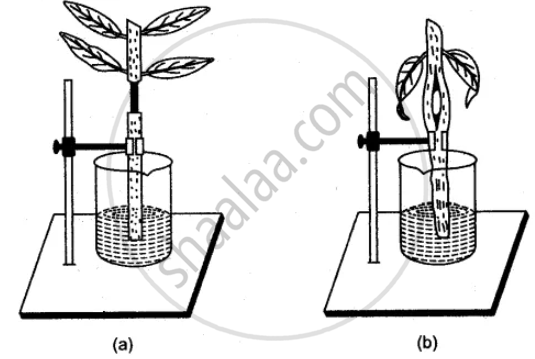
(i) What is the aim of the experiment?
(ii) Some parts of the stem in both the shoots have been removed. Name the conducting tissue in shoot A and in shoot B, that has been removed.
(iii) What are the results of this experiment?
A thin strip of epidermal cells of a leaf was observed in a drop of water. They all looked turgid and normal.
(a) Draw a diagram of such a cell.
(b) Draw a diagram of a cell if this strip is transferred to a strong concentrated solution of sugar. What is term used for the effect on the cells ?
The unbranched root hair in plants is formed from ____________.
Paheli uprooted a rose plant from the soil. Most of the root tips, with root hairs, got left behind in the soil. She planted it in a pot with new soil and watered it regularly. Will the plant grow or die? Give reason for your answer.
Give other name of epidermal cells in roots of plants.
