Advertisements
Advertisements
प्रश्न
Given below is an apparatus which was setup to investigate a physiological process in plants. The setup was placed in bright sunlight. Answer the questions that follow:
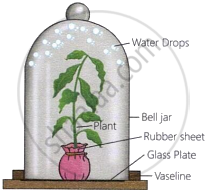
- Name the process being studied. Define the process.
- Why was the pot enclosed in a rubber sheet?
- Mention two external factors which can accelerate the above process.
- List two adaptations in plants to reduce the above process.
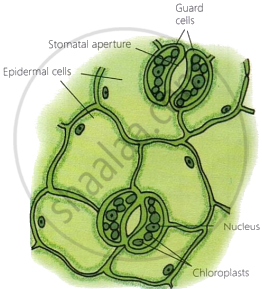
- Draw a neat, labelled diagram of a stomatal apparatus.
Given below is an apparatus which was setup to investigate a physiological process in plants. The setup was placed in bright sunlight. Answer the questions that follow:
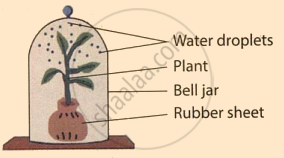
- Name the process being studied. Define the process.
- Why was the pot enclosed in a rubber sheet?
- Mention two external factors which can accelerate the above process.
- List two adaptations in plants to reduce the above process.
- Draw a neat, labelled diagram of a stomatal apparatus.
Advertisements
उत्तर
- The process being studied is Transpiration. Transpiration is the process during which water is lost in the form of water vapour through the aerial parts of the plant.
- The pot was enclosed in a rubber sheet to prevent evaporation of water from the soil.
- Two external factors which can accelerate transpiration are:
- Bright sunlight
- Low humidity
- Two adaptations in plants to reduce the above process are:
- Sunken stomata
- Narrow leaves
संबंधित प्रश्न
Mention the two ways in which transpiration helps the plants.
Which of the following statements are true and which ones are false? Give reason in support of your answer.
Hydathodes are similar to stomata in plant physiology.
Briefly explain how the rate of transpiration is affected by
Intensity of light
Given below is an apparatus which has setup to investigate a physiological process in plants. The setup was placed in bright sunlight. Answer the questions that follow: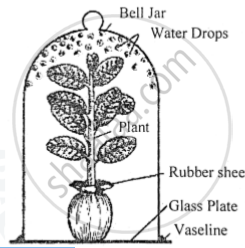
List two adaptations in plants to reduce the above process.
Give Reasons for the following:
Land plants die if their roots remain waterlogged.
Name the three types of transpiration.
The following diagram is set up to demonstrate an experiment.
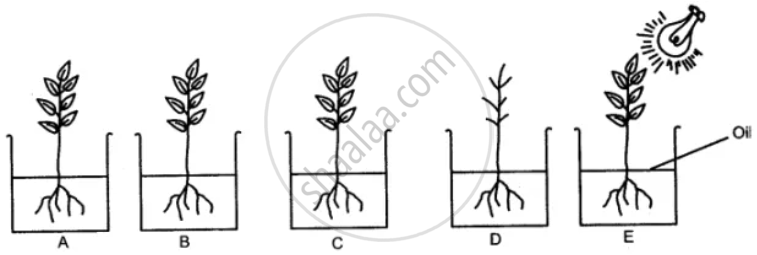 Five plants A, B, C, D, and E were placed in a beaker containing water. The water in each beaker was covered with a layer of oil. The leaves were removed from plant D in plant B, upper surfaces of all the leaves were covered with Vaseline, in-plant C the lower surfaces of all the leaves were covered with Vaseline and plant E was exposed to strong light. The beakers were then left for a few hours and at the end of the experimental period, weights of each beaker were taken.
Write the correct answer out of the five available choices given under each question:
I. In which beaker would you expect the greatest decrease in weight?
(i) A (ii) B (iii) C (iv) D (v) E
II. In which beaker the change of weight would be minimum?
(i) A (ii) B (iii) C (iv) D (v) E
III. Which plant would remain healthy for a longer period of time?
(i) A (ii) B (iii) C (iv) D (v) E
IV. In this experiment which plant can be considered as the uncontrolled one?
(I) A (ii) B (iii) C (iv) D (v) E
V. The difference of weight would b maximum between:
(i) A and B (ii) A and C (iii) A and D (iv) A and E (v) D and E
Mention, if the following statement is True or False. If false rewrite the wrong statement in its correct form:
Root hairs are the extensions of the outer epidermal cells of the root
Mention, if the following statement is True or False. If false rewrite the wrong statement in its correct form:
Transpiration takes place only in green plants
Write the functional activity of the following structure:
Lenticels
