Advertisements
Advertisements
प्रश्न
Given below is an apparatus which has setup to investigate a physiological process in plants. The setup was placed in bright sunlight. Answer the questions that follow:
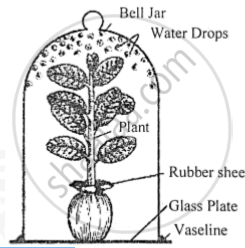
List two adaptations in plants to reduce the above process.
Advertisements
उत्तर
Presence of thick cuticle
Sunken stomata
leaves converted into Spines
APPEARS IN
संबंधित प्रश्न
Distinguish between the following:
Transpiration and evaporation
The figure given below represents an experimental setup with a weighing machine to demonstrate a particular process in plants. The experimental setup was placed in bright sunlight. Study the diagram and answer the following questions.

When the weight of the test tubes A and B is taken before and after the experiment, what change is observed? Justify.
Explain the Term
Transpiration
Differentiate Between Cuticular and Lenticular transpiration.
The figure given below represents an experimental setup with a weighing machine to demonstrate a particular process in plants. The experimental set-up was placed in bright sunlight. Study the diagram and answer the following questions:

- Name the process intended for the study.
- Define the above mentioned process.
- When the weight of the test tubes (A and B) is taken before and after the experiment, what is observed? Give reasons to justify your observations in A & B.
- What is the purpose of keeping the test tube B in the experimental set-up?
- What is the purpose of putting oil in the test tube?
Complete the following sentence with appropriate word:
Transpiration is the loss of water__________________from the leaves of the plant.
Mention, if the following statement is True or False. If false rewrite the wrong statement in its correct form:
Root hairs are the extensions of the outer epidermal cells of the root
Write the functional activity of the following structure:
Cuticle
An outline sketch of a tree is shown in a diagram below. Study the same and answer the questions that follow:

- Name and define the phenomenon labelled A in the diagram.
- Write the significance of the process mentioned in A for the plants.
- What do the direction of the arrows in B and C indicate? Name the phenomena.
- Draw a neat and labelled diagram of an opened stomata.
