Advertisements
Online Mock Tests
Chapters
1: Cell Cycle and Cell Division
2: Structure of Chromosome
3: Genetics
Unit 2: Plant Physiology
4: Absorption by Roots
▶ 5: Transpiration
Chapter 6: Photosynthesis
Chapter 7: Chemical Coordination in Plants
Unit 3: Human Anatomy and Physiology
Chapter 8: Circulatory System
Chapter 9: Human Excretory System
Chapter 10: Nervous System
Chapter 11: Sense Organs
Chapter 12: Endocrine System
Chapter 13: Reproductive System
Unit 4: Population
Chapter 14: Population
Unit 5: Human Evolution
Chapter 15: Human Evolution
Unit 6: Pollution
Chapter 16: Pollution
![Lakhmir Singh solutions for बायोलॉजी [अंग्रेजी] कक्षा १० आईसीएसई chapter 5 - Transpiration - Shaalaa.com](/images/biology-english-class-10-icse_6:7181a54a5d284da8b50dd2f92022a1f6.jpg "Lakhmir Singh solutions for बायोलॉजी [अंग्रेजी] कक्षा १० आईसीएसई chapter 5 - Transpiration")
Advertisements
Solutions for Chapter 5: Transpiration
Below listed, you can find solutions for Chapter 5 of CISCE Lakhmir Singh for बायोलॉजी [अंग्रेजी] कक्षा १० आईसीएसई.
Lakhmir Singh solutions for बायोलॉजी [अंग्रेजी] कक्षा १० आईसीएसई 5 Transpiration Intex Quesions [Pages 76 - 82]
TEST YOUR UNDERSTANDING -1 Fill in the Blanks
Cobalt chloride paper changes from blue to ______ on absorbing moisture.
Ganong's potometer measures the water ______ by the plant.
In transpiration, the water is lost in the form of ______.
True or False.
Rate of transpiration is high in desert plants.
True or False.
Loss of weight in a plant before and after a set of conditions indicate loss of water through transpiration.
True or False.
The rate of transpiration is the same in all the plants.
Multiple Choice Questions
At what time the weight of plant is measured in the weighing method of measuring transpiration?
Before experiment
After experiment
Both before and after the experiment
None of these
Ganong's potometer may not give accurate results due to:
Use of cut twig
Variation in temperature
Both use of cut twig and variation in temperature
None of these
THINK AND ANSWER
Why do leaves of some plants wilt during midday inspite of there being plenty of water in the soil?
Do you know how plants affect the climate of an area?
Does age of a plant affect the rate of transpiration?
Does transpiration mean excretion for the plants?
TEST YOUR UNDERSTANDING - 2 Fill in the Blanks
Lenticels are the openings in the bark of woody ______.
Transpiration is regulated by the movements of ______.
______ is more in the lower surface of the leaf.
True or False.
90% of total transpiration is done by stomata.
True or False.
Thickness of cuticle affects the rate of transpiration.
True or False.
Transpiration is highest during winters.
Multiple Choice Questions
Rate of transpiration is not affected by ______.
age of plant
light
wind
humidity
Transpiration pull is due to ______.
high soil water
loss of water by cells
high CO2 levels
none of these
TEST YOUR UNDERSTANDING - 3 Fill in the Blanks
______ are pores through which xylem sap is excreted.
Rate of transpiration decreases with an increase in ______.
Thick ______ cuts down the rate of transpiration.
True or False.
Humidity promotes transpiration in plants.
True or False.
Sunken stomata are present in xerophytes.
True or False.
Guttation occurs during midday.
Multiple Choice Questions
Most of transpiration in tall trees occurs through ______.
stomata
lenticels
cuticles
hydathodes
The rate of transpiration increases with an increase in ______.
atmospheric pressure
wind velocity
humidity
level of carbon dioxide
Lakhmir Singh solutions for बायोलॉजी [अंग्रेजी] कक्षा १० आईसीएसई 5 Transpiration EXERCISE [Pages 83 - 86]
Objective Questions
True or False.
Rate of respiration affects rate of transpiration.
True or False.
Transpiration will be fastest when the day is hot, dry and windy.
True or False.
The change in colour of litmus paper is an indicator of demonstration of transpiration.
True or False.
In a leaf, the cell sap in each cell exerts a wall pressure outward on the cell wall.
True or False.
The opening and closing of stomata is regulated by the guard cells.
Fill in the Blanks
Exudation of sap from injured or cut part of a plant is ______.
Sunken stomata are a feature of plants growing in ______.
In cactus, the leaves are modified into ______ to reduce transpiration.
More transpiration occurs from the ______ surface of the leaf.
Special pores at the tip of veins through which guttation occurs is ______.
Match the Following.
| Column I | Column II |
| (i) Lenticels | (a) Nerium |
| (ii) Cobalt chloride paper | (b) Banana leaf |
| (iii) Sunken stomata | (c) Leaf tip |
| (iv) Hydathodes | (d) Woody stem |
| (v) Guttation | (e) Transpiration |
Give One Word Answer.
A scientist name used for measuring rate of transpiration.
Give One Word Answer.
Part of leaf that allows transpiration.
Give One Word Answer.
Cell sap in rubber tree.
Give One Word Answer.
The outer waxy covering of epidermis.
Give One Word Answer.
Device to measure the rate of transpiration.
Multiple Choice Questions
Which of the following is not a function of stomata?
Loss of water
Exchange of gases
Regulation of turgidity of cells
Loss due to guttation
Which among the following is an external factor affecting transpiration?
Cuticle
Leaf orientation
Number of stomata
Humidity
One of the internal factors that affect rate of transpiration is:
Age of leaf
Colour of leaf
Sunken stomata
Light
Transpiration will be maximum during ______ day.
Rainy and windy
Hot, dry and windy
High humidity and low temperature
High humidity and breezy
From which part of the leaf does most water evaporates from?
Cuticle
Guard cells
Mesophyll cells
Xylem vessels
Descriptive Questions Short Answer Questions
Why is transpiration considered as a necessary evil?
Write the different types of transpiration in plants.
What is the significance of sunken stomata? Where are they found?
Write three factors that affect transpiration.
Give two examples of Guttation.
Give two examples of Bleeding.
Give two examples of Sunken stomata.
How does the rate of transpiration differ during windy day?
How does the rate of transpiration differ during hot day?
How does the rate of transpiration differ during humid day?
What is a potometer?
Mention the drawbacks of potometer.
Why are potassium ions necessary for plants?
Define the following term:
Transpiration
Define the following:
Guard cells
Define the following term:
Cuticle
Define the following term:
Hydathodes
Differentiate between transpiration and guttation.
Distinguish between the following:
Transpiration and evaporation
Mention the differences between stomatal and lenticular transpiration.
Differentiate between guttation and bleeding in plants.
Long Answer Questions
Give reason for the following:
If you uproot a plant from the soil, its leaves soon wilt.
Explain the mechanism of closing and opening of the stomata.
Explain the experiment of Ganong's potometer.
Describe the methods to measure transpiration in plants.
Explain the mechanism that brings about closure of stomata.
Write the external factors that influences transpiration.
Write the internal factors that influences transpiration.
Write the experiment to measure transpiration in plants using cobalt chloride paper.
Diagram Based Questions
The diagram below represents an experiment to demonstrate a certain phenomenon in a green plant:
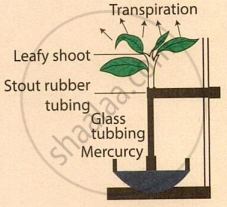
- Will the level of mercury in the glass tubing rise or fall?
- Which conducting tissue of the plant does the glass-tubing represent?
- Define transpiration.
- How will the rate of the above process differ if the environment of the plant has
- Less humidity
- High temperature?
Given below is an apparatus which was setup to investigate a physiological process in plants. The setup was placed in bright sunlight. Answer the questions that follow:
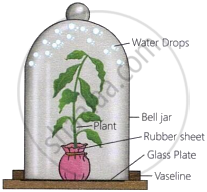
- Name the process being studied. Define the process.
- Why was the pot enclosed in a rubber sheet?
- Mention two external factors which can accelerate the above process.
- List two adaptations in plants to reduce the above process.
- Draw a neat, labelled diagram of a stomatal apparatus.
The diagram of an given below demonstrates a particular process in plants. Study the same and answer the questions that follow:
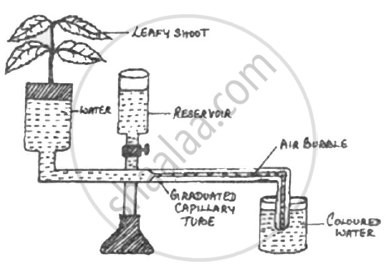
- Name the apparatus.
- Which phenomenon is demonstrated by this apparatus?
- Explain the phenomenon mentioned in (ii) above.
- State two limitations of using this apparatus.
- What is the importance of the air bubble in the experiment?
- Name the structures in a plant through which the above process takes place.
DO IT RIGHT
Find out how to calculate the number of stomata in a leaf.
[Hint: Field view (V) = Radius (r) = Diameter/2]
Area of field view = πr2
Density of stomata = `"Number of stomata"/"Area of field view"`]
The field view (V) = 0.13 mm2
The density of stomata (D) = ______ per mm
Total number of stomata over 1 mm2 = V × D = ______
A Spanish oak tree has ______ stomata per mm2.
Learn to calculate the surface area of leaf.
Take a leaf. Draw the leaf on a graph paper. Remove the leaf from the graph paper. Count the squares and half squares (as you have learnt in Mathematics).
Total surface area of the leaf (in cm2) = ______
After you find out the leaf surface area of your leaf, now calculate the water loss according to conditions mentioned in the table below:
| Condition | Total Water Loss after 30 minutes (in ml) | Leaf Surface Area in cm2 | Leaf Surface Area in m2 (divide cm2 by 10,000 or 104) | Water loss in ml/m2/ 30 minutes |
| Room (control) | 0.005 | |||
| Bright light | 0.007 | |||
| Fan (wind) | 0.009 | |||
| Foggy day | 0.003 |
Write the full form of the measurement: MPa. What is it used for?
Write the requirement of this in atmosphere, leaf, xylem, roots and soil.
Solutions for 5: Transpiration
Lakhmir Singh solutions for बायोलॉजी [अंग्रेजी] कक्षा १० आईसीएसई chapter 5 - Transpiration
Shaalaa.com has the CISCE Mathematics बायोलॉजी [अंग्रेजी] कक्षा १० आईसीएसई CISCE solutions in a manner that help students grasp basic concepts better and faster. The detailed, step-by-step solutions will help you understand the concepts better and clarify any confusion. Lakhmir Singh solutions for Mathematics बायोलॉजी [अंग्रेजी] कक्षा १० आईसीएसई CISCE 5 (Transpiration) include all questions with answers and detailed explanations. This will clear students' doubts about questions and improve their application skills while preparing for board exams.
Further, we at Shaalaa.com provide such solutions so students can prepare for written exams. Lakhmir Singh textbook solutions can be a core help for self-study and provide excellent self-help guidance for students.
Concepts covered in बायोलॉजी [अंग्रेजी] कक्षा १० आईसीएसई chapter 5 Transpiration are .
Using Lakhmir Singh बायोलॉजी [अंग्रेजी] कक्षा १० आईसीएसई solutions Transpiration exercise by students is an easy way to prepare for the exams, as they involve solutions arranged chapter-wise and also page-wise. The questions involved in Lakhmir Singh Solutions are essential questions that can be asked in the final exam. Maximum CISCE बायोलॉजी [अंग्रेजी] कक्षा १० आईसीएसई students prefer Lakhmir Singh Textbook Solutions to score more in exams.
Get the free view of Chapter 5, Transpiration बायोलॉजी [अंग्रेजी] कक्षा १० आईसीएसई additional questions for Mathematics बायोलॉजी [अंग्रेजी] कक्षा १० आईसीएसई CISCE, and you can use Shaalaa.com to keep it handy for your exam preparation.
