Advertisements
Online Mock Tests
Chapters
1: Cell Cycle and Cell Division
2: Structure of Chromosome
3: Genetics
Unit 2: Plant Physiology
4: Absorption by Roots
5: Transpiration
6: Photosynthesis
7: Chemical Coordination in Plants
Unit 3: Human Anatomy and Physiology
8: Circulatory System
9: Human Excretory System
10: Nervous System
11: Sense Organs
12: Endocrine System
13: Reproductive System
Unit 4: Population
14: Population
Unit 5: Human Evolution
▶ 15: Human Evolution
Unit 6: Pollution
16: Pollution
![Lakhmir Singh solutions for बायोलॉजी [अंग्रेजी] कक्षा १० आईसीएसई chapter 15 - Human Evolution - Shaalaa.com](/images/biology-english-class-10-icse_6:7181a54a5d284da8b50dd2f92022a1f6.jpg "Lakhmir Singh solutions for बायोलॉजी [अंग्रेजी] कक्षा १० आईसीएसई chapter 15 - Human Evolution")
Advertisements
Solutions for Chapter 15: Human Evolution
Below listed, you can find solutions for Chapter 15 of CISCE Lakhmir Singh for बायोलॉजी [अंग्रेजी] कक्षा १० आईसीएसई.
Lakhmir Singh solutions for बायोलॉजी [अंग्रेजी] कक्षा १० आईसीएसई 15 Human Evolution Intex Quesions [Pages 265 - 275]
TEST YOUR UNDERSTANDING - 1
True or False.
Wisdom tooth is an example of analogous organs.
True or False.
Archaeopteryx is a connecting link between the reptiles and the birds.
Fill in the Blanks
To know how old any fossil is, ______ and ______ methods are used.
The structures which are functionally similar but structurally different are called ______.
Multiple Choice Questions
The use and disuse of organs was proposed by ______.
Charles Darwin
Lamarck
Weismann
None of these
Forearm of human, forelimb of horse and wings of bat are examples of ______.
Homologous organs
Analogous organs
Vestigial organs
Embryonic development
Analogous organs arise due to ______.
divergent evolution
artificial selection
genetic drift
convergent evolution
Which is not a vestigial organ in man?
Nictitating membrane
Tail vertebrae
Vermiform appendix
Nails
THINK AND ANSWER
After the death of two insects, one of the insects was buried in hot mud and the other in usually found mud. Which of the two is more likely to be preserved better and why?
Does geographical isolation of individuals of a species lead to formation of a new species? Provide a suitable explanation.
TEST YOUR UNDERSTANDING - 2
True or False.
The mutation theory of evolution was proposed by Lamarck.
True or False.
Darwin proposed the theory of natural selection.
Fill in the Blanks
The process by which new species develop from the existing species is known as ______.
Variation amongst species population occur due to ______ which is the raw material of evolution.
Multiple Choice Questions
Darwin's theory of evolution failed to talk about ______.
transmission of variation
role of environment
survival of the fittest
overpopulation
During industrial revolution, the black soot on the tree bark hid the ______.
light-coloured moths
dark-coloured moths
yellow-coloured moths
black- and white-coloured moths
Fossils are generally found in ______.
sedimentary rocks
igneous rocks
metamorphic rocks
topsoil
Which of the following are the two key concepts of Darwinian theory of evolution?
Genetic drift and Mutation
Adaptive radiation and Homology
Mutation and Natural selection
Branching descent and Natural selection
TEST YOUR UNDERSTANDING - 3
True or False.
The common ancestor to both man and ape is Dryopithecus.
True or False.
The remains of Homo sapiens, were first discovered in Europe and were named Australopithecus.
True or False.
All the ancestors of human evolution came first from Africa.
Multiple Choice Questions
The name Homo sapiens was given by ______ to human beings.
Darwin
Lamarck
Carolus Linnaeus
Weismann
The stage of human evolution which showed obligate bipedalism.
Australopithecus
Homo habilis
Homo erectus
Neanderthal
The brain capacity of Homo erectus was about ______.
650 cm3
900 cm3
1500 cm3
1400 cm3
Which of the following statements is correct?
Australopithecus had large brain around 900 cm3.
Neanderthal man lived in East Africa.
Homo erectus had brain capacity 900 cm3.
Homo sapiens arose in Central Asia and moved to other continents and developed into distinct races.
Which of the following statement is correct regarding evolution of mankind?
Homo erectus is preceded by Homo habilis.
Neanderthal man and Cro-Magnon man were living at the same time.
Australopithecus were living in Australia.
None of these
Lakhmir Singh solutions for बायोलॉजी [अंग्रेजी] कक्षा १० आईसीएसई 15 Human Evolution EXERCISE [Pages 276 - 282]
Objective Questions True or False
True or False.
Evolution is considered to be a unifying principle of biology since it explains both the unity and diversity of life.
True or False.
According to Darwin, selective breeding is most responsible for evolution.
True or False.
Body parts found in different species that are structurally similar are said to be analogous structures.
True or False.
Genetics is a process of biological changes in a species over time.
True or False.
A phenotype that allows an organism to survive and reproduce is a(n) vestigial structure.
True or False.
Biodiversity is the variety of different life forms within an area.
True or False.
Organisms that are related but have evolved to become different over time have a similar habitat.
Fill in the Blanks
Body parts found in different species that serve a similar function are said to be ______ structures.
______ can be described as the survival of the biggest and the strongest.
A ______ is a group of similar organisms that can breed and produce fertile offspring.
Charles Darwin wrote ______.
The brain size of Neanderthals was ______.
Match the following.
| Column I | Column II |
|---|---|
| (i) Natural selection | (a) Convergent evolution |
| (ii) Inheritance of acquired characters | (b) Genetic drift |
| (iii) Analogous structures | (c) Charles Darwin |
| (iv) Gene flow by chance | (d) Lamarckism |
| (v) Fossil | (e) Archaeopteryx |
| (vi) Probable ancestor of birds | (f) Remains of prehistoric life |
Give One Word Answer:
Study of fossils.
Give One Word Answer:
Organs which are similar in structure and origin but perform different functions.
Give One Word Answer:
Imperfectly developed (non-functional) organs found in the body.
Give One Word Answer:
Scientist who proposed the theory of inheritance of acquired characters.
Give One Word Answer:
Primate or extinct ape, deemed to be the ancestors of both man and apes.
Multiple Choice Questions
The bones of forelimbs of whale, bat, cheetah and man are similar in structure, because ______.
one organism has given rise to another
they share a common ancestor
they perform the same function
the have biochemical similarities
they have cytological similarities
The theory of Natural Selection was given by ______.
Lamarck
Alfred Wallace
Charles Darwin
Oparin and Haldane
Replacement of the lighter-coloured variety of peppered moth to its darker variety in England is the example of ______.
Natural selection
Regeneration
Genetic isolation
Temporal isolation
The theory of spontaneous generation stated that ______.
life arose from living forms only
life can arise from both living and non-living
life can arise from non-living things only
life arises spontaneously, neither from living nor from the non-living
The extinct stone ancestor, who ate only fruits and hunted with stone weapons was ______.
Ramapithecus
Australopithecus
Dryopithecus
Homo erectus
One of the oldest, best preserved and most complete hominid fossils commonly known as 'Lucy' belongs to the genus
Australopithecus
Oreopithecus
Dryopithecus
Pithecanthropus
Which one of the following phenomena supports Darwin's concept of Natural Selection in organic evolution?
Development of transgenic animals
Production of "Dolly", the sheep by cloning
Prevalence of pesticide resistant insects
Development of organs from 'stem cells' for organ transplantation
Which one is not a vestigial organ?
Wings of kiwi
Coccyx in man
Pelvic girdle of python
Flipper of seal
By the statement 'survival of the fittest', Darwin meant that
the strongest of all species survives
the most intelligent of the species survives
the cleverest of the species survives
the species most adaptable to changes survives
According to Lamarckism, long-necked giraffes evolved because ______.
nature selected only long-necked ones
humans preferred only long-necked ones
short necks suddenly changed into long necks
of stretching of necks over many generations by short-necked ones
Genetic drift operates only in ______.
island populations
smaller populations
larger populations
Mendelian populations
The factors involved in the formation of new species are ______.
isolation and competition
gene flow and competition
competition and mutation
isolation and variation
The extinct human who lived 1,00,000 to 40,000 years ago, in East and Central Asia, used hides to protect their bodies and had brain capacity of 1400 cm3 were:
Homo habilis
Neanderthal man
Cro-Magnon man
Ramapithecus
Arrange and rewrite the terms in group in correct order to be in a logical sequence, beginning with the term that is underlined:
Australopithecus, Cro-Magnon, Homserectus, Neanderthal man, Homs sapiens
Descriptive Questions Short Answer Questions
When did human evolution begin?
What function did wisdom tooth perform?
With which group of animals do humans share their immediate ancestors?
Define the following term:
Evolution
Define the following term:
Variations
Define gene pool.
Define the term of species.
Define the following term:
Vestigial organs
How does natural selection help in evolution? Give an example.
Differentiate between the Following:
Evolution and Variation
Write down the difference between homologous and analogous organs.
Differentiate between Lamarck's Theory and Darwin's Theory.
Differentiate between the Following:
Natural selection and Adaptation
Differentiate between divergent evolution and convergent evolution with one example for each.
Long Answer Questions
What are the two major contributions of Charles Darwin regarding evolution? Describe briefly.
Explain the most valid theory about the origin of life on earth.
How does Darwin's theory of Natural Selection explain new forms of life on earth?
What are the characteristics that have developed in human beings during evolution?
Explain with an example for the given, how the following provides evidence in favor of evolution in organisms:
Homologous organs
Explain with an example for the given, how the following provides evidence in favor of evolution in organisms :
Analogous organs
Explain vestigeal organs as evidence of evolution.
Diagram Based Questions
Look at the figures and answer the following questions:
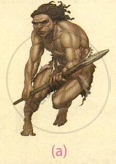
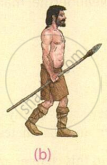
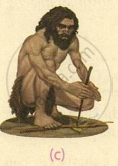
- Identify and write the names of the evolving stages of human.
- Write two features of each stage.
- Write the complete classification of human (Kingdom to Species).
- State the common features between apes and humans.
Given below are two stages in the evolution of man. Study them and answer the question that follow.
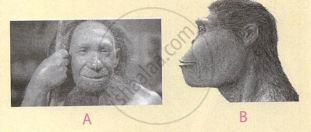
- Identify Australopithecus and Neanderthal man from the pictures.
- Mention two characteristic features each for the two stages.
- Who proposed the theory of 'Natural Selection'?
- Give two examples of vestigial organs in human.
DO IT RIGHT
Use the Internet to trace the evolutionary stages of any one animal, e.g., panther. Discuss your research with your teacher and classmates.
Make a chart as in 'concept map' given in this chapter and stick it in you class bulletin board. Use colourful chart papers and glitter pens to make the chart attractive.
Complete the table below to make a detailed chart on the different stages of human.
| Various stages | Found in | Lived during | Height (m) | Characteristics |
|---|---|---|---|---|
| Australopithecus (First Ape man) |
Cranial capacity: Size of canine teeth: Forehead and brow: Chin development: Body hair: Posture: Bipedalism: |
|||
| Homo habilis (Handy man) |
Cranial capacity: Size of canine teeth: Forehead and brow: Chin development: Body hair: Posture: Bipedalism: |
|||
| Homo erectus (Erect man) |
Cranial capacity: Size of canine teeth: Forehead and brow: Chin development: Body hair: Posture: Bipedalism: |
|||
| Neanderthal | Cranial capacity: Size of canine teeth: Forehead and brow: Chin development: Body hair: Posture: Bipedalism: |
|||
| Cro-Magnon | Cranial capacity: Size of canine teeth: Forehead and brow: Chin development: Body hair: Posture: Bipedalism: |
|||
| Modern man | Cranial capacity: Size of canine teeth: Forehead and brow: Chin development: Body hair: Posture: Bipedalism: |
Crossword - Unit V
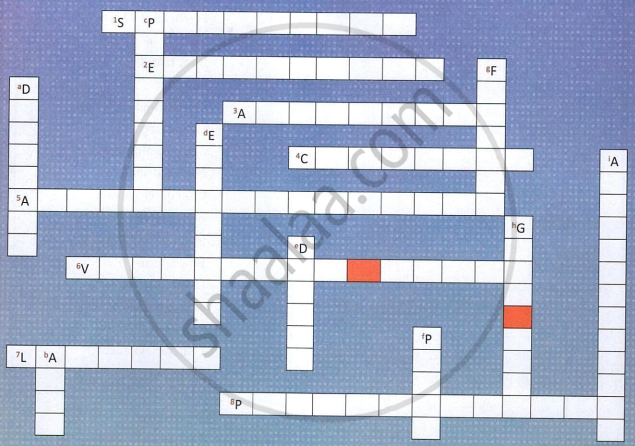
ACROSS
- Process how a new kind of plant or animal species is created
- Dying out of a species
- Structures which are functionally similar but structurally different
- The era which started 66 million years ago
- First human-like ancestor
- Any small degenerated or imperfectly developed organ
- Gave Theory of Inheritance of Acquired Characters
- Study of fossils
DOWN
- Extinct carnivorous or herbivorous reptiles
- Clade of Old-World simians native to sub-Saharan Africa and Southeast Asia
- An ancient flying reptile which lived on the earth
- Process by which different living organisms are believed to have developed from earlier forms
- Gave Theory of Natural Selection
- Vestigial part of ear that pick-up sound waves
- Remains or impression of a prehistoric plant or animal embedded and preserved in rock
- Combination of all the genes present in a species
- Fossil bird with reptilian features
Solutions for 15: Human Evolution
Lakhmir Singh solutions for बायोलॉजी [अंग्रेजी] कक्षा १० आईसीएसई chapter 15 - Human Evolution
Shaalaa.com has the CISCE Mathematics बायोलॉजी [अंग्रेजी] कक्षा १० आईसीएसई CISCE solutions in a manner that help students grasp basic concepts better and faster. The detailed, step-by-step solutions will help you understand the concepts better and clarify any confusion. Lakhmir Singh solutions for Mathematics बायोलॉजी [अंग्रेजी] कक्षा १० आईसीएसई CISCE 15 (Human Evolution) include all questions with answers and detailed explanations. This will clear students' doubts about questions and improve their application skills while preparing for board exams.
Further, we at Shaalaa.com provide such solutions so students can prepare for written exams. Lakhmir Singh textbook solutions can be a core help for self-study and provide excellent self-help guidance for students.
Concepts covered in बायोलॉजी [अंग्रेजी] कक्षा १० आईसीएसई chapter 15 Human Evolution are .
Using Lakhmir Singh बायोलॉजी [अंग्रेजी] कक्षा १० आईसीएसई solutions Human Evolution exercise by students is an easy way to prepare for the exams, as they involve solutions arranged chapter-wise and also page-wise. The questions involved in Lakhmir Singh Solutions are essential questions that can be asked in the final exam. Maximum CISCE बायोलॉजी [अंग्रेजी] कक्षा १० आईसीएसई students prefer Lakhmir Singh Textbook Solutions to score more in exams.
Get the free view of Chapter 15, Human Evolution बायोलॉजी [अंग्रेजी] कक्षा १० आईसीएसई additional questions for Mathematics बायोलॉजी [अंग्रेजी] कक्षा १० आईसीएसई CISCE, and you can use Shaalaa.com to keep it handy for your exam preparation.
