Advertisements
Online Mock Tests
Chapters
1: Cell Cycle and Cell Division
2: Structure of Chromosome
3: Genetics
Unit 2: Plant Physiology
4: Absorption by Roots
5: Transpiration
6: Photosynthesis
7: Chemical Coordination in Plants
Unit 3: Human Anatomy and Physiology
8: Circulatory System
9: Human Excretory System
10: Nervous System
11: Sense Organs
12: Endocrine System
13: Reproductive System
Unit 4: Population
▶ 14: Population
Unit 5: Human Evolution
Chapter 15: Human Evolution
Unit 6: Pollution
Chapter 16: Pollution
![Lakhmir Singh solutions for बायोलॉजी [अंग्रेजी] कक्षा १० आईसीएसई chapter 14 - Population - Shaalaa.com](/images/biology-english-class-10-icse_6:7181a54a5d284da8b50dd2f92022a1f6.jpg "Lakhmir Singh solutions for बायोलॉजी [अंग्रेजी] कक्षा १० आईसीएसई chapter 14 - Population")
Advertisements
Solutions for Chapter 14: Population
Below listed, you can find solutions for Chapter 14 of CISCE Lakhmir Singh for बायोलॉजी [अंग्रेजी] कक्षा १० आईसीएसई.
Lakhmir Singh solutions for बायोलॉजी [अंग्रेजी] कक्षा १० आईसीएसई 14 Population Intex Quesions [Pages 235 - 248]
TEST YOUR UNDERSTANDING - 1
True or False.
Population is distributed evenly throughout the world.
True or False.
The main cause of increase in India's population is low birth rate.
True or False.
Early marriage is one of the factors responsible for population growth.
Fill in the Blanks
______ is the ratio of birth to death within a population.
______ is the science of population.
______ is the complete study of human population after every 10 years.
Multiple Choice Questions
If in an area, birth rate is 45 per thousand and death rate is 25 per thousand, what would be the natural growth rate?
15 per thousand
18 per thousand
20 per thousand
25 per thousand
Which one of the following is the main reason for rapid increase in population of India?
High birth rate and high death rate
Low birth rate and low death rate
High birth rate and low death rate
Low birth rate and high death rate
THINK AND ANSWER
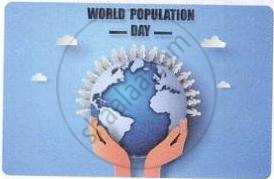
- When do we celebrate World Population Day?
- Who declared this day?
- Write when it first started and what is the main aim to celebrate this day.
- Do we celebrate this day in India or in your school? Write your views on it.
TEST YOUR UNDERSTANDING - 2
Give One Word Answer:
Record of group of organisms or people present in a country.
The biological/technical term for the number of persons living per square kilometre at any given time.
Give One Word Answer:
The number of people living in an area increase effecting the available resources of a country.
Multiple Choice Questions
Number of live births in a year per total population × 1000
Birth rate
Death rate
Vital index
Sex ratio
Factors which is not responsible for overpopulation in India
Decline in birth rate
Decline in death rate
Poverty
Social issues
Economic depression, low income and unemployment are reasons for ______.
Under population in India
Population explosion in India
Equal sex ratio in India
Maintaining vital index in India
True or False.
Large families do not have difficulties in finding housing, giving food and educating their children.
True or False.
Urbanisation and job availability has made people move from rural areas to urban cities causing increase in population density.
True or False.
Indian government has taken many initiatives to bring down the country's population.
True or False.
Social marketing has not helped in educating public on overpopulation effects.
TEST YOUR UNDERSTANDING - 3 Fill in the Blanks
______ is the method to remove unwanted foetus from the mother's body.
The family planning symbol is ______.
______ in males and ______ in females are used to prevent sperms to fertilise the ovum.
To stop ovulation in females, doctors prescribed ______ pills.
True or False.
Vasectomy is a surgical family planning method done in females.
True or False.
Rhythm method is considered not a reliable and safe method of family planning.
True or False.
Educating and creating awareness through several mediums do not have any impact on family planning.
Lakhmir Singh solutions for बायोलॉजी [अंग्रेजी] कक्षा १० आईसीएसई 14 Population EXERCISE [Pages 250 - 254]
Objective Questions True or False
True or False.
India has 25% of the world's population.
True or False.
Density of population is low in India.
True or False.
India ranks 1st in the world in terms of population.
True or False.
There has been positive growth rate of population since 1921.
True or False.
Demography is the study of the workings of city life.
Fill in the Blanks
______ is an intrauterine device inserted in the female body to stop implantation.
______ should be imparted to young teenagers to make them know their body and be aware of other consequences.
Due to ______ and ______ degradation, people migrate to urban areas in search of work and better life.
______ revolutions are responsible for growth in population in this world.
The advancement of ______ science, many illness have been cured and ______ rate has reduced resulting in population explosion.
Match the Following:
| Column I | Column II |
|---|---|
| (i) Industrial Revolution | (a) Study of human population |
| (ii) Census | (b) Ratio of natality to mortality × 100 |
| (iii) Infant mortality rate | (c) Record of a country's population in 10 years |
| (iv) Demography | (d) Reason for overpopulation |
| (v) Vital index | (e) Factor of population growth |
Give One Word Answer:
Human population studied through data collection and analysis.
Give One Word Answer:
Number of live births per 1,000 people per year.
Give One Word Answer:
A surgical method of fertility control in human males.
Give One Word Answer:
Percentage increase in the growth of population per year.
Give One Word Answer:
Ten years record of human population in a country.
Give One Word Answer:
Method to control number of children per family in order to reduce a country's population.
Multiple Choice Questions
According to the census 2001, which was the largest state of India demographically?
Maharashtra
Bihar
Uttar Pradesh
West Bengal
The density of population in India is defined as ______.
Number of persons in an area of one mile square
Number of persons in an area of one lakh mile square
Number of persons in an area of one lakh km square
Number of persons in an area of one km square
What is the main reason behind the faster population growth in India?
Low birth rate and low mortality rate
High birth rate and low mortality rate
Faster birth rate and faster mortality rate
High birth rate and high mortality rate
According to census 2011, which union territory records the highest density?
Delhi
Chandigarh
Puducherry
West Bengal
Which of the following is called the biggest leap forward in the history of Indian population?
1921–1931
1941–1951
1951–1961
1961–1971
Sex ratio in India is ______.
981 males for 1000 females
2000 males for 2068 females
1068 males for 1000 females
1068 males for 1068 females
In general it is observed that the rate of population growth has been ______ in the densely populated areas compared to sparsely populated areas.
Low
High
Negligible
Almost the same
The Indian state with lowest sex ratio is ______.
Haryana
Punjab
Uttar Pradesh
Arunachal Pradesh
The birth rate measures the birth during a year per ______.
100 populace
1000 populace
10000 populace
100000 populace
Find the name of the state which has the lowest density.
Meghalaya
Mizoram
Arunachal Pradesh
Sikkim
Surgical method of sterilisation in a woman involves cutting and tying of ______.
Ureter
Uterus
Urethra
Oviduct
Descriptive Questions Short Answer Questions
What is a census?
State two reasons for the increase in birth rate in India.
What is MTP?
What will be the world's population by the year 2027 and 2046?
Write the methods used for family planning.
What do you understand by the slogan "Hum do, Humare do"?
When was the National Population Policy formulated in India?
When was family planning campaign first started in a big way in India?
Define the terms Rate of growth of population.
Define the following term:
Population
Explain the Term: Population density
Give suitable biological reasons for the following statement:
The birth rate in India is very high.
Differentiate between the Following;
Population and Population density
Distinguish between Birth and Death Rate.
Differentiate between the Following:
Growth rate and Natural growth rate
Differentiate between tubectomy and vasectomy.
Long Answer Questions
List any four reasons for population explosion in India.
Compare India's population with that of the world population.
What is the effect of overpopulation in India?
How does population growth influence urbanisation and environmental degradation?
Write the methods used for family planning.
Suggest measures to check population growth rate in India.
Diagram Based Questions
Look at the figure and answer the following questions:
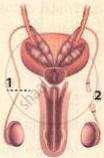
- What method is being followed?
- What is the benefit of this method?
- What are 1 and 2?
- State the function of 1 and 2.
Answer the following questions by observing the figure.

- What does the symbol denote?
- What kind of awareness does the government want to create by this symbol?
- Has this awareness benefitted India's population? How? Give details.
Observe the graph and answer the following questions:
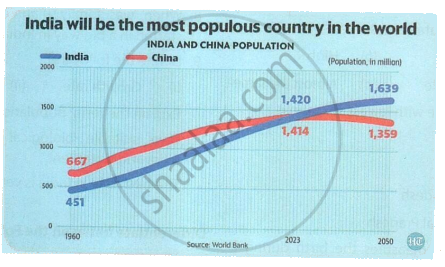
- What do you understand from the graph?
- China’s population is more than India’s. How has it been able to reduce its growth than India? Justify by giving examples.
DO IT RIGHT
Collect the following information from your vicinity for about 10–15 households:
- Name of the person interviewed ______.
- Age ______ Years ______
- Academic Qualification ______
- Number of persons earning in the family ______
- Total no. of members M ______ F ______
- Members of family in the age groups
- Up to 14 years ______
- 15 years to 60 years ______
- More than 60 years ______
- Based on the data collected above, compute and analyse:
- Sex-ratio ______
- Dependency ratio ______
- Children below 14 years ______ and its percentage ______
- Adult more than 60 years ______ and its percentage ______
- Make a table containing data you have collected.
- Compare data in your table with that of your classmates. Check:
- Population of the area
- Density of population
- The Economic Times has published data as follows:
| 2016: 31 mega cities | 2030: 41 mega cities | ||||
|---|---|---|---|---|---|
| 1 | Tokyo | 38.1 | 1 | Tokyo | 37.2 |
| 2 | Delhi | 26.5 | 2 | Delhi | 36.1 |
| 3 | Shanghai | 24.5 | 3 | Shanghai | 30.8 |
| 4 | Mumbai | 21.4 | 4 | Mumbai | 27.8 |
| 5 | São Paulo | 21.3 | 5 | Beijing | 27.7 |
| 6 | Beijing | 21.2 | 6 | Dhaka | 27.4 |
| 7 | Mexico City | 21.2 | 7 | Karachi | 24.8 |
| 8 | Osaka | 20.3 | 8 | Cairo | 24.5 |
| 9 | Cairo | 19.1 | 9 | Lagos | 24.2 |
| 10 | New York-Newark | 18.6 | 10 | Mexico City | 23.9 |
| 14 | Kolkata | 15.0 | 15 | Kolkata | 19.1 |
| 28 | Bengaluru | 10.5 | 21 | Bengaluru | 14.8 |
| 30 | Chennai | 10.2 | 24 | Chennai | 13.9 |
| Source: The World's Cities in 2016, UN DESA; figures in millions, Mega cities: Urban agglomerations of over 10 million population | 28 | Hyderabad | 12.8 | ||
| 38 | Ahmedabad | 10.5 | |||
What do you understand from the data?
Crossword - Units III and IV
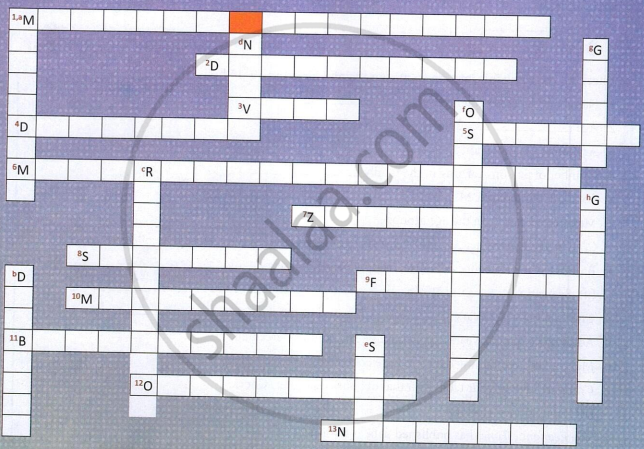
ACROSS
- Lowest portion of the brain that controls the activities of the internal organs
- It is the statistical study of human population
- Type of blood vessel that conduct the blood from the tissues to the heart
- A relaxation phase of a chamber of the heart
- The white outer layer of the eyeball
- Secretion of adrenal gland that helps to maintain Na/K concentration in blood
- Fertilised cell formed after the union of male and female gametes
- A contraction phase of a chamber of the heart
- A small sac-like structure containing the ovum
- Number of deaths in one period of time or in one place
- The fluid-filled space inside the blastocyst
- Process of formation of female gametes
- The structural and functional unit of the kidney
DOWN
- Disease caused by the hyposcretion of thyroid gland in adults
- A disease caused by increase or decrease of insulin level in the blood
- Process of absorption of the usable substances from the glomerular filtrate back into the circulation
- A bundle of fibres of different neurons
- Part that is body's central support structure
- Process of regulating the concentration and osmotic pressure of the blood
- A condition due to lack of iodine in the diet
- A tuft of blood capillaries formed from the afferent arteriole
Solutions for 14: Population
Lakhmir Singh solutions for बायोलॉजी [अंग्रेजी] कक्षा १० आईसीएसई chapter 14 - Population
Shaalaa.com has the CISCE Mathematics बायोलॉजी [अंग्रेजी] कक्षा १० आईसीएसई CISCE solutions in a manner that help students grasp basic concepts better and faster. The detailed, step-by-step solutions will help you understand the concepts better and clarify any confusion. Lakhmir Singh solutions for Mathematics बायोलॉजी [अंग्रेजी] कक्षा १० आईसीएसई CISCE 14 (Population) include all questions with answers and detailed explanations. This will clear students' doubts about questions and improve their application skills while preparing for board exams.
Further, we at Shaalaa.com provide such solutions so students can prepare for written exams. Lakhmir Singh textbook solutions can be a core help for self-study and provide excellent self-help guidance for students.
Concepts covered in बायोलॉजी [अंग्रेजी] कक्षा १० आईसीएसई chapter 14 Population are .
Using Lakhmir Singh बायोलॉजी [अंग्रेजी] कक्षा १० आईसीएसई solutions Population exercise by students is an easy way to prepare for the exams, as they involve solutions arranged chapter-wise and also page-wise. The questions involved in Lakhmir Singh Solutions are essential questions that can be asked in the final exam. Maximum CISCE बायोलॉजी [अंग्रेजी] कक्षा १० आईसीएसई students prefer Lakhmir Singh Textbook Solutions to score more in exams.
Get the free view of Chapter 14, Population बायोलॉजी [अंग्रेजी] कक्षा १० आईसीएसई additional questions for Mathematics बायोलॉजी [अंग्रेजी] कक्षा १० आईसीएसई CISCE, and you can use Shaalaa.com to keep it handy for your exam preparation.
