Advertisements
Online Mock Tests
Chapters
1: Cell Cycle and Cell Division
▶ 2: Structure of Chromosome
3: Genetics
Unit 2: Plant Physiology
4: Absorption by Roots
5: Transpiration
6: Photosynthesis
7: Chemical Coordination in Plants
Unit 3: Human Anatomy and Physiology
8: Circulatory System
9: Human Excretory System
10: Nervous System
11: Sense Organs
12: Endocrine System
13: Reproductive System
Unit 4: Population
14: Population
Unit 5: Human Evolution
15: Human Evolution
Unit 6: Pollution
16: Pollution
![Lakhmir Singh solutions for बायोलॉजी [अंग्रेजी] कक्षा १० आईसीएसई chapter 2 - Structure of Chromosome - Shaalaa.com](/images/biology-english-class-10-icse_6:7181a54a5d284da8b50dd2f92022a1f6.jpg "Lakhmir Singh solutions for बायोलॉजी [अंग्रेजी] कक्षा १० आईसीएसई chapter 2 - Structure of Chromosome")
Advertisements
Solutions for Chapter 2: Structure of Chromosome
Below listed, you can find solutions for Chapter 2 of CISCE Lakhmir Singh for बायोलॉजी [अंग्रेजी] कक्षा १० आईसीएसई.
Lakhmir Singh solutions for बायोलॉजी [अंग्रेजी] कक्षा १० आईसीएसई 2 Structure of Chromosome Intex Quesions [Pages 25 - 27]
TEST YOUR UNDERSTANDING - 1 Fill in the Blanks
Chromosomes are thought to have been discovered in 1842 by ______.
______ is a unit of DNA on a chromosome that controls a specific characteristic of an organism.
Interphase ______ shows the chromatin network.
True or False.
Chromatin network is present in a highly diffused and uncoiled form in the interphase nucleus.
True or False.
The chromosome extremities or terminal regions, on either side are called telophase.
THINK AND ANSWER
The cells of the leaf tip of a plant contain 20 chromosomes. Each cell of the pollen tetrad of such a plant would contain:
4 chromosomes
10 chromosomes
16 chromosomes
20 chromosomes
“Cell division is a type of reproduction in unicellular organism.” Justify.
TEST YOUR UNDERSTANDING - 2 Fill in the Blanks
______ and ______ gave the semi-conservative model of replication.
Each DNA nucleotide consists of a ______, a ______ and a phosphate group.
True or False.
DNA is the hereditary material in humans only as it contains the genetic information.
True or False.
DNA is formed in all reproducing cell and the process is known as DNA transcription.
True or False.
The gametes are called reproductive cells, which contain only half the amount of DNA.
Lakhmir Singh solutions for बायोलॉजी [अंग्रेजी] कक्षा १० आईसीएसई 2 Structure of Chromosome EXERCISE [Pages 29 - 31]
Objective Questions
True or False.
Chromosomes other than the pair of sex chromosomes are called alleles.
True or False.
Chromosomes are thread-like structures usually present in the nucleus and cytoplasm of a cell.
True or False.
Chromosomes occur only during the cell duplication.
True or False.
During DNA replication, multiple copies of DNA are formed in a reproducing cell.
True or False.
In submetacentric chromosome, the centromere is present right in the centre and both the arms are equal.
Fill in the Blanks
Chromosomes are made up of nucleic acid and ______.
______ are the two copies of a chromosome that are attached to the common centromere.
Chromosomal proteins have two components ______ and ______.
In DNA, adenine will pair with ______ and guanine will pair with ______.
Genes have to carry ______ of parents to their children or progeny.
Match the Following:
| Column I | Column II |
| (i) TMV | (a) Ribonucleic acid |
| (ii) RNA | (b) Tobacco mosaic virus |
| (iii) Haploid | (c) Body cells |
| (iv) Diploid | (d) Contains four nitrogenous bases |
| (v) Telocentric | (e) Gametes |
| (vi) DNA | (f) Position of centromere at proximal end |
Give One Word Answers.
Expand the biological abbreviation of DNA.
Give an appropriate biological/technical term for the following:
A pair of corresponding chromosomes of the same size and shape, one from each parent.
Give One Word Answers.
The complex consisting of DNA strand and a core of histones.
Name the following.
The non-dividing phase of the cell cycle where more DNA is synthesised.
Read the explanation given below and name the structure:
The point of attachment of two chromatids of a chromosome.
Name the repeating components of each DNA strand lengthwise.
Multiple Choice Questions
Select the statements that describe characteristics of genes
- genes are specific sequence of bases in a DNA molecule
- a gene does not code for proteins
- in individuals of a given species, a specific gene is located on a particular chromosome
- each chromosome has only one gene
(i) and (ii)
(i) and (iii)
(i) and (iv)
(ii) and (iv)
Genetic material of a eukaryotic cell contained in ______.
nucleolus
nucleus
nucleoplasm
nucleoid
Chromosomes are made up of
DNA
protein
DNA and protein
RNA
A gene is a ______.
hybrid
heritable trait
pure breed
part of a chromosome that transmits a trait
The number of pair(s) of sex chromosomes in the zygote of humans is ______.
one
two
three
four
Descriptive Questions Short Answer Questions
Briefly explain the following:
Chromatin network
Which molecules are present in chromatin?
What is diploid number?
What is haploid number?
Explain the term gene.
State the exact location of the Centromere
State the difference between:
Chromosome and chromatid
Differentiate between
Chromatin and Chromosome.
Differentiate between centrosome and centromere.
Differentiate between the following:
DNA and Histone
Long Answer Questions
Describe the structure of the chromosome in brief.
How are chromatin, chromatid and chromosomes related to each other?
What are genes?
Explain the importance of genes.
Explain the types of chromosomes on the basis of position of centromere.
Discuss the semi-conservative model of replication.
Diagram Based Questions
Draw a duplicate chromosome and label its part.
Identify the types of chromosomes and write one difference.
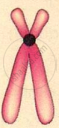
(a)
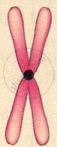
(b)
A double helical structure of DNA is given here; answer the following:
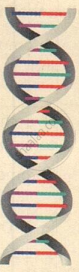
- Name all the nitrogenous bases that form a DNA molecule.
- Expand DNA.
- Nitrogenous base A pairs with ______ and guanine pairs with ______.
- Name the hereditary material that contains genetic information.
DO IT RIGHT
Your subject teacher gave you to complete the tables given below. Note a few points while doing the task. Fill in the space with correct elements.
- 'Ploidy' word has been used in Table 1. What does it mean?
- Where did the word chromosome come from?
- What does monoploidy, diploidy, tetraploidy and pentaploidy mean?
- What does 2n or 2x mean?
- Find the meaning of: (a) genome (b) somatic.
| Table 1. Plants | ||
| Crops | Chromosome number | Ploidy level |
| Rice | Diploid | |
| Potato | 2x = 48 | |
| 2x = | Tetraploid | |
| Tomato | ||
| 3x = | Triploid | |
| Table 2. Animals | ||
| Name | Chromosome number | Genus and species |
| Cat | ||
| Canis familiaris | ||
| 38 | ||
| Ovis aries | ||
| 60 | ||
| Horse | ||
Solutions for 2: Structure of Chromosome
Lakhmir Singh solutions for बायोलॉजी [अंग्रेजी] कक्षा १० आईसीएसई chapter 2 - Structure of Chromosome
Shaalaa.com has the CISCE Mathematics बायोलॉजी [अंग्रेजी] कक्षा १० आईसीएसई CISCE solutions in a manner that help students grasp basic concepts better and faster. The detailed, step-by-step solutions will help you understand the concepts better and clarify any confusion. Lakhmir Singh solutions for Mathematics बायोलॉजी [अंग्रेजी] कक्षा १० आईसीएसई CISCE 2 (Structure of Chromosome) include all questions with answers and detailed explanations. This will clear students' doubts about questions and improve their application skills while preparing for board exams.
Further, we at Shaalaa.com provide such solutions so students can prepare for written exams. Lakhmir Singh textbook solutions can be a core help for self-study and provide excellent self-help guidance for students.
Concepts covered in बायोलॉजी [अंग्रेजी] कक्षा १० आईसीएसई chapter 2 Structure of Chromosome are .
Using Lakhmir Singh बायोलॉजी [अंग्रेजी] कक्षा १० आईसीएसई solutions Structure of Chromosome exercise by students is an easy way to prepare for the exams, as they involve solutions arranged chapter-wise and also page-wise. The questions involved in Lakhmir Singh Solutions are essential questions that can be asked in the final exam. Maximum CISCE बायोलॉजी [अंग्रेजी] कक्षा १० आईसीएसई students prefer Lakhmir Singh Textbook Solutions to score more in exams.
Get the free view of Chapter 2, Structure of Chromosome बायोलॉजी [अंग्रेजी] कक्षा १० आईसीएसई additional questions for Mathematics बायोलॉजी [अंग्रेजी] कक्षा १० आईसीएसई CISCE, and you can use Shaalaa.com to keep it handy for your exam preparation.
