Advertisements
Advertisements
प्रश्न
Why is transpiration considered as a necessary evil?
Advertisements
उत्तर
Transpiration is considered a necessary evil because it is both vital for a plant's survival and potentially harmful to it. It is necessary because it creates a powerful transpiration pull that helps in the upward conduction of water and minerals from the roots to the leaves, and it also regulates the plant's temperature by providing a cooling effect. However, it acts as an evil because it causes an enormous loss of water (nearly 98% of absorbed water) through evaporation. If the water availability in the soil is low, this continuous loss can lead to wilting, dehydration, and ultimately the death of the plant.
APPEARS IN
संबंधित प्रश्न
Water reaches great heights in the trees because of suction pull caused by ______.
Which of the following helps in the upward movement of water and dissolved minerals from the roots to the leaves through the stem?
Under what conditions do plant transpire most slowly?
The set up shown alongside was kept in sunlight for an hour. It was observed that drops of water appeared on the inside of the polyethylene bag.
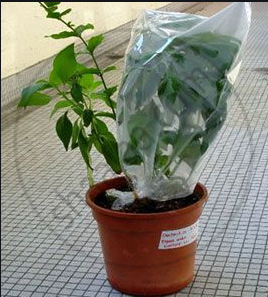
- Name the process which is being demonstrated.
- Why was the pot and its soil left uncovered by the polythene bag?
- Why was the pot left in the sunlight?
- Suppose the pot in this experiment was placed inside a dark room instead of placing it in sunlight for some time. What difference will be noticed?
Define the term Transpiration stream
Give suitable explanation for the following:
Cork and bark of trees help in preventing loss of water
Distinguish between the following :
Cuticular transpiration and lenticular transpiration
Describe an experiment to prove that transpiration occurs more from the undersurface of dorsiventral leaves.
During transpiration, there is a loss of ______
Keep some freshly cut flowers in a solution of food colour. Wait for sometime for the dye to rise in the flower, when the stem of the flower is held up in light, coloured strands can be seen inside. Can this experiment demonstrate which tissue is conducting water up the stem?
