Advertisements
Advertisements
प्रश्न
Why is transpiration considered as a necessary evil?
Advertisements
उत्तर
Transpiration is considered a necessary evil because it is both vital for a plant's survival and potentially harmful to it. It is necessary because it creates a powerful transpiration pull that helps in the upward conduction of water and minerals from the roots to the leaves, and it also regulates the plant's temperature by providing a cooling effect. However, it acts as an evil because it causes an enormous loss of water (nearly 98% of absorbed water) through evaporation. If the water availability in the soil is low, this continuous loss can lead to wilting, dehydration, and ultimately the death of the plant.
APPEARS IN
संबंधित प्रश्न
Transpiration is defined as:
The percentage of cuticular transpiration in plants is approximately ______.
An apparatus as shown below was set up to investigate a physiological process in plants. The setup was kept in sunlight for two hours. Droplets of water were then seen inside the bell jar. Answer the questions that follow:

Suggest a suitable control for this experiment.
An apparatus as shown below was set up to investigate a physiological process in plants. The setup was kept in sunlight for two hours. Droplets of water were then seen inside the bell jar. Answer the questions that follow:
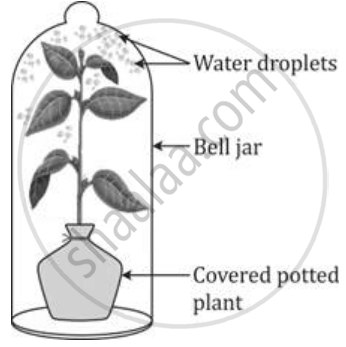
Mention two ways in which this process is beneficial to plants.
Mention, if the following statement is True or False. If false rewrite the wrong statement in its correct form:
Moist cobalt chloride paper is blue in colour.
Identify the wrong statement and correct it.
Leaves perform the function of transpiration only.
Which one is not related to transpiration?
How can plants be grown under limited water supply without compromising on metabolic activities?
Name the structures through which Transpiration occur in a plant.
Define the following term:
Wilting
