Advertisements
Advertisements
प्रश्न
Name the following:
The solution outside the cell having lower solute concentration than the fluids.
Advertisements
उत्तर
Hypotonic
संबंधित प्रश्न
Multiple Choice Question:
Put a tick mark (✓) against the correct alternative in the following statement:
The root-hairs are suited for absorbing water from the soil because:
Given below is the diagrammatic representation of the transverse section of a part of a plant. Study it and answer the questions that follow:
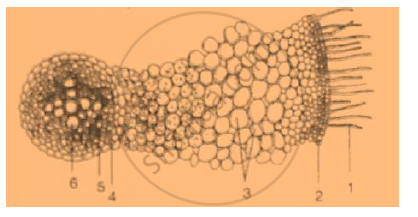
(a) Name the part of the plant that is shown
(b) Label the parts 1 to 6
(c) Write the functions of parts 3 and 5
Study the diagram given below and answer the questions that follow:

- Name the process being studied in the above experiment.
- Explain the process mentioned in (a) above
- Why is oil placed over water?
- What do we observe with regard to the level of water when this set-up is placed in (1) bright sunlight, (2) humid conditions and (3) windy days?
- Mention any three adaptations found in plants to foster the process mentioned in (a) above
Three plants (a), (b) and (c) were placed in beakers containing coloured water. The water in each beaker was covered with a layer of oil. The leaves were removed from plant (b), while plant (c) was exposed to strong light.
(i) In which plant, (a), (b) or (c) would the water move up the fastest?
(ii) In which plant (a), (b) or (c), would the water move up slowly?
(iii) Why was the water covered with a layer of oil?
(iv) What is being investigated by this experiment?

Name the following:
Water is absorbed from the soil by which part.
Most plant cells and tissues constitutes _____ % water.
In the zone of absorption, epidermal cells form unicellular hair-like extensions called ________.
Identify the part of the plants which is responsible for maximum absorption of water.
