Advertisements
Advertisements
प्रश्न
The diagram given below is of an experiment just at the start. Study the diagram carefully and answer the following questions :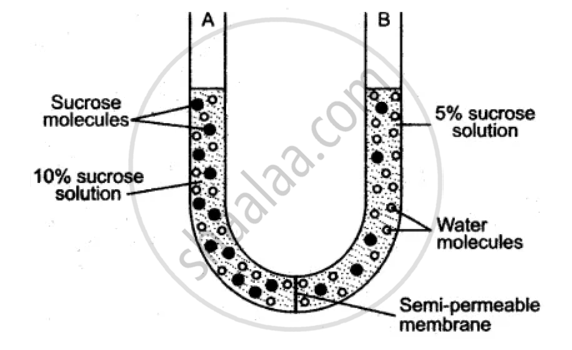
(i) What does the experiment demonstrate?
(ii) Define, the process demonstrated in the experiment.
(iii) What changes are observed after a few hours?
(iv) Give two examples of a semi-permeable membrane.
(v) Which limb of the U-tube contains a more concentrated sucrose solution, A or B?
(vi) Why is the membrane separating the two solutions labeled as semi-permeable membrane?
Advertisements
उत्तर
(i) The process of osmosis.
(ii) Osmosis is a special type of diffusion of solvent molecules through a semi-permeable membrane from a region of their higher concentration to the lower concentration region, but not vice versa.
(iii) The level of water in column A will rise along with the passage of time and will ultimately stop when the concentration of water molecules are equal on both sides of the membrane.
(iv) (a) Parchment paper, (b) Egg membrane.
(v) Solution A.
(vi) It permits the movement of only water molecules to pass through it.
संबंधित प्रश्न
Give the appropriate biological or technical term for the following.
Movement of molecules of a substance from their higher concentration to lower concentration when they are in direct contact.
Complete the following statements:
Hypotonic solution is one in which the solution kept outside the cell has lower solute concentration than ……………… the cell.
Give reason for the following:
Potato cubes, when placed in water, become firm and increase in size.
Give Reasons for the following.
It is necessary to maintain a normal osmotic concentration of the blood.
Differentiate between:
Osmosis and Diffusion
The diagram below represents an experimental set up to demonstrate a vital process. Study the same and then answer the questions that follow:
(i) Name the process.
(ii) Define the above named process.
(iii) What would you observe in the experimental setup after an hour or so?
(iv) What control experiment can be set up for the above experiment?
(v) Keeping in mind the root hair cell and its surrounding name the part that corresponds to (1) Concentrated sugar solution, (2) Parchment paper, (3) Water in the beaker.
(vi) Name any other substance that can be used instead of parchment paper in the above experiment.
(vii) Mention two advantages of this process to the plant.
Name the following:
Name the process by which water enters the root hair cell.
Mention, if the following statement is True or False. If false rewrite the wrong statement in its correct form:
The plasma membrane permits the passage of all solutes and water.
DPD of a cell can be expressed as ______
The given statement is incorrect. Rewrite the correct statement:
Fresh water fish when placed in hypertonic salt solution absorb water and burst.
