English

A leaf cell of a water plant was placed in a liquid other than pond water. After sometime, it assumed a shape as shown below: Give the term for the state of the cell it has acquired.

Advertisements
Advertisements

Question

A leaf cell of a water plant was placed in a liquid other than pond water. After sometime, it assumed a shape as shown below:
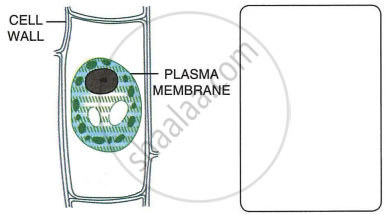
  1. Give the term for the state of the cell it has acquired.
  2. Name the structure which acts as a selectively permeable membrane.
  3. Comment on the nature (tonicity) of the liquid surrounding the cell.
  4. Name any one feature of this plant cell which is not present in an animal cell.
  5. Redraw in the space provided, the diagram of the cell if it is soon placed in ordinary water for some time.
Answer in Brief
Advertisements

Solution

  1. Flaccid Cell (Plasmolysis)
  2. Plasma membrane
  3. Hypertonic solution
  4. Presence of cell wall

shaalaa.com
  Is there an error in this question or solution?
Chapter 4: Absorption by roots: The Processes Involved - Review Questions [Page 55]

APPEARS IN

Selina Concise Biology [English] Class 10 ICSE
Chapter 4 Absorption by roots: The Processes Involved
Review Questions | Q E. 1. | Page 55

RELATED QUESTIONS

A plant cell may burst when :


What is the difference between ‘flaccid’ and ‘turgid’? Give one example of flaccid condition in plants. 


Give reason for the following:

It is better to transplant seedlings in a flower-bed in the evening and not in the morning.


 Give suitable biological reasons for the following statement: 
Root hairs become flaccid and droop when excess fertilizers are added to the moist soil around them. 


Differentiate between the following:

Plasmolysis and Deplasmolysis.


The below diagram represents a plant cell after being placed in a strong sugar solution. Guidelines 1 to 5 indicate the following:

1. Cell wall
2. Plasma membrane.
3. Protoplasm
4. Large vacuole
5. Nucleus
Study the diagram and answer the questions that follow :
(i) What is the state of the cell shown in the diagram?
(ii) Name the structure which acts as a selectively permeable membrane.
(iii) If the cell had been placed in distilled water instead of a strong sugar solution which features: would not have been present?
(iv) If the cell in the diagram possessed chloroplasts where would these be present?
(v) Name any one feature of this plant cell which is not present in animal cells.


Mention, if the following statement is True or False. If false rewrite the wrong statement in its correct form:

Flaccidity is the reverse of turgidity.


Fill in the Blank
Wilting and drooping of leaves is due to loss of ________.


Addition of salt to pickles is a method of killing the bacteria by ______.


Given below is the figure of a plant cell showing different kinds of pressure acting upon it. Study the figure and answer the questions that follow:

  1. In the figure, 1, 2 and 3 represent:
    1. Cytoplasm, Nucleus, Vacuole respectively
    2. Vacuole, Cytoplasm, Cell wall respectively.
    3. Cytoplasm, Cell membrane and vacuole respectively.
    4. Cytoplasm, Cell wall and Vacuole respectively.
  2. B in the figure represents:
    1. Osmotic pressure
    2. Turgor pressure
    3. Wall pressure
    4. Diffusion pressure
  3. A in the figure represents:
    1. irnbibition pressure
    2. Wall pressure
    3. Turgor pressure
    4. Osmotic pressure
  4. C in the figure represents:
    1. Turgor pressure
    2. Osmotic pressure
    3. Wall pressure
    4. Imbibition pressure
  5. Draw a neat and labelled diagram of a plasmolyzed plant cell.

Share
Notifications

Englishहिंदीमराठी


      Forgot password?
Use app×