Advertisements
Advertisements
Question
Fill in the Blank
Wilting and drooping of leaves is due to loss of ________.
Advertisements
Solution
Wilting and drooping of leaves is due to loss of Turgidity.
RELATED QUESTIONS
The diagram given below represents a plant cell after being placed in a strong sugar solution. Study the diagram and answer the questions that follow:

- What is the state of the cell shown in the diagram?
- Name the structure that acts as a selectively permeable membrane.
- Label the parts numbered 1 to 4 in the diagram.
- How can the above cell be brought back to its original condition? Mention the scientific term for the recovery of the cell.
- State any two features of the above plant cell which is not present in animal cells.
Explain Turgor pressure
The state of a cell in which the cell wall is rigid and stretched by the increase in volume due to the absorption of water is called.
Distinguish between the following:
Flaccid condition and turgid condition
Differentiate between:
Turgid and Flaccid.
The below diagram represents a plant cell after being placed in a strong sugar solution. Guidelines 1 to 5 indicate the following: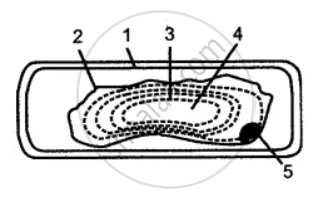
1. Cell wall
2. Plasma membrane.
3. Protoplasm
4. Large vacuole
5. Nucleus
Study the diagram and answer the questions that follow :
(i) What is the state of the cell shown in the diagram?
(ii) Name the structure which acts as a selectively permeable membrane.
(iii) If the cell had been placed in distilled water instead of a strong sugar solution which features: would not have been present?
(iv) If the cell in the diagram possessed chloroplasts where would these be present?
(v) Name any one feature of this plant cell which is not present in animal cells.
Name the following:
The condition in which the contents of a cell exert pressure against the cell wall making it distended.
Excessive use of fertilisers in agricultural fields reduces the yield of crops. Justify the statement.
The figure given below is a diagrammatic representation of a part of the cross-section of the root in the root hair zone. Study the same and then answer the questions that follow:

- The parts labelled as 1, 2, 3 and 4 are:
- Root hair, Xylem vessel, Soil particles, Cortex respectively.
- Xylem vessel, Soil particles, Root hair, Cortex respectively.
- Root hair, Xylem vessel, Cortex, Soil particles respectively.
- Cortex, Soil particles, Xylem vessel, Root hair respectively.
- The process that enables the passage of water from soil into the root hair is:
- Diffusion
- Active transport
- Osmosis
- Passive absorption
- The kind of force which exists between a liquid and any surface is called as:
- Cohesive force
- Adhesive force
- Capillarity
- Suction force
- The kind of force between the same kind of liquid molecules is:
- Capillary force
- Transpirational pull
- Adhesive force
- Cohesive force
- Sometimes exudation of water occurs from the margin of the leaves in the early morning or night. It is termed as:
- Transpiration
- Guttation
- Bleeding
- Osmosis
