Advertisements
Advertisements
प्रश्न
Draw a diagram to display the vertical view of human female reproductive system and label the following parts in the diagram:
(1) Ureter
(2) Ovary
(3) Funnel of fallopian tube
(4) Urethra.
Advertisements
उत्तर

APPEARS IN
संबंधित प्रश्न
Write the function of the following part in a human female reproductive system:
Fallopian tube
What do the testes in a man produce?
The ratio of the number of chromosomes in a human zygote and a human sperm is ______
X and Y are two human beings. The organ A in the reproductive system of X releases a mature gamete B once a month which goes into a tube-like structure C through a funnel-like opening. The organ D in the reproductive system of Y makes and releases gametes E which pass through a duct F and are introduced by an organ of Y, into the body of X. B and E fuse together in C to form a new cell G. The cell G divides repeatedly to form a ball of cells H which gets embedded in the lining of organ I of reproductive system of X where it grows and develops into a baby.
(a) Name (i) organ A, and (ii) gamete B.
(b) Write two names of tube-like structure C.
(c) Name (i) organ D, and (ii) gamete E.
(d) Write two names of duct F.
(e) Name (i) cell G (ii) ball of cells H, and (iii) organ I.
(f) Out of X and Y, which one is (i) male, and (ii) female?
The below diagram is of a developing embryo is a mother’s womb:
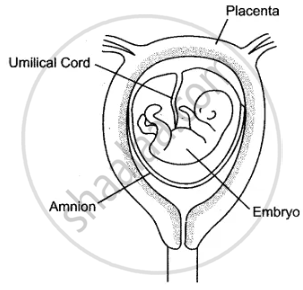
(i) Write the functions of the placenta, amnion, and umbilical cord.
(ii) How are the waste products of a fetus removed?
(iii) What is the gestation period?
Choose the Odd One Out:
Choose the Odd One Out:
Which one of the following statements about human sperm is correct?
Mention any two changes that are common to both boys and girls in early teenage years.
Which of the following correctly pairs a reproductive function with its description?
