Advertisements
Advertisements
प्रश्न
The diagram alongside represents the structure found in the inner ear. Study the same and then answer the questions that follow:
(i) Name the parts labelled A, B, C and D.
(ii) Name the parts of the ear responsible for transmitting impulses to the brain.
(iii) Name the part labelled above which is responsible for:
1. Static equilibrium. 2. Dynamic equilibrium. 3. Hearing
(iv) Name the audio receptor cells which pick up vibrations.
(v) Name the fluid present in the inner ear.

Advertisements
उत्तर
(i) A - Semi-circular canal
B - Utriculus
C - Sacculus
D - Cochlea
(ii) Auditory nerve.
(iii) 1. Utriculus and sacculus
2. Semi-circular canal
3. Cochlea
(iv) Sensory cells of organ of Corti
(v) Perilymph
APPEARS IN
संबंधित प्रश्न
Draw labelled diagrams of the following: Ear
The unit of frequency is ______.
Mention the exact location of the Eustachian tube
Briefly explain the following terms: Power of accommodation
Name the following:
The part which equalises the air pressure in the middle and external ear.
Name the following:
The tube which connects the cavity of the middle ear with the throat.
What is the biological term for the three small bones present in the middle ear collectively?
The figure below is the sectional view of a part of the skull showing s sense organ:
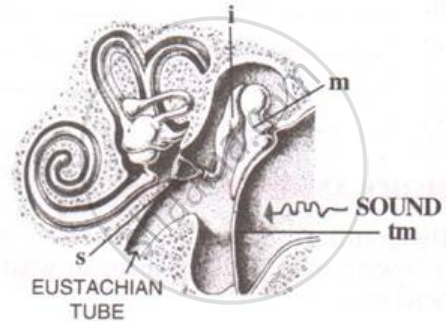
Name the sense organ.
Given below is the diagram of the human ear. Study the diagram and then answer the questions that follow:

(i) What role does the eardrum play in hearing?
(ii) What common term is given to the parts labeled A, B, and E?
(iii) Would there be any difference if these three parts mentioned in (ii) above were replaced by one by one? Why?
(iv) Give the biological term for the parts labeled C and D.
(v) Name the fluid which fills the parts mentioned in (iv) above.
(vi) State the functions of the ear.
The spiral organ possessing sensory cells for hearing is ______.
