Advertisements
Advertisements
प्रश्न
The diagram alongside represents the structure found in the inner ear. Study the same and then answer the questions that follow:
(i) Name the parts labelled A, B, C and D.
(ii) Name the parts of the ear responsible for transmitting impulses to the brain.
(iii) Name the part labelled above which is responsible for:
1. Static equilibrium. 2. Dynamic equilibrium. 3. Hearing
(iv) Name the audio receptor cells which pick up vibrations.
(v) Name the fluid present in the inner ear.

Advertisements
उत्तर
(i) A - Semi-circular canal
B - Utriculus
C - Sacculus
D - Cochlea
(ii) Auditory nerve.
(iii) 1. Utriculus and sacculus
2. Semi-circular canal
3. Cochlea
(iv) Sensory cells of organ of Corti
(v) Perilymph
APPEARS IN
संबंधित प्रश्न
Name the following:
The tube which connects the cavity of the middle ear with the throat.
State whether the following statements are true (T) or false (F). If false, correct them by changing any one single word in each.
Deafness is caused due to rupturing of the pinna.
Mention if the following statement is true (T) or false (F) Give reason.
The auditory nerve is purely for perceiving sound
There are three small bones in the muddle ear – anvil, hammer and stirrup :
(a) Which of these bones is in touch with ear-drum ?
(b) Which of these bones is in touch with oval window ?
Write whether the following is true or false:
The part of the ear associated with balance is the cochlea.
The figure below is the sectional view of a part of the skull showing a sense organ:
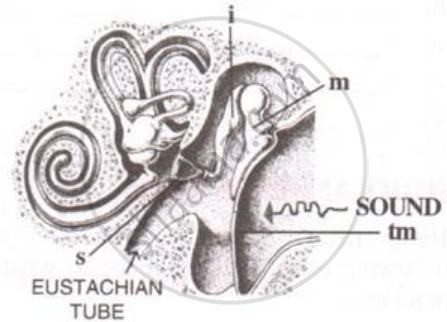
Name the part labeled 'tm'. What is its function?
Choose the Odd One Out:
List the causes of noise pollution.
State the functions of the following:
Auditory nerve
Note the relationship between the first two words and suggest the suitable word/words for the fourth place.
Semi-circular canal : Ampulla :: Cochlea : ______.
