Advertisements
Advertisements
प्रश्न
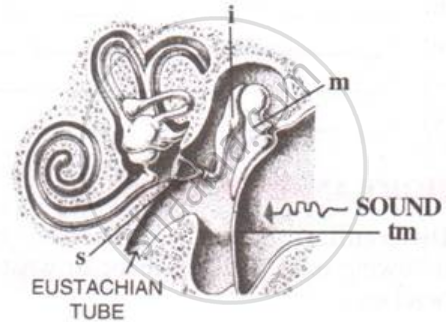
The following diagram refers to the ear of a mammal.

(i) Label the parts 1 to 10 to which the guidelines point.
(ii) Which structure:
(a) converts sound waves into mechanical vibrations?
(b) Converts vibrations into nerve impulses?
(c) Responds to change in position?
(d) Transmits impulses to the brain?
(e) Equalizes atmospheric pressure and pressure in the ear.
Advertisements
उत्तर
(i)
1. Cochlea.
2. Auditory nerve.
3. Semi-circular canals.
4. Ear ossicles.
5. Auditory meatus.
6. Pinna.
7. Er drum.
8. Fenestra rotunda.
9. Eustachian tube.
10. Fenestra ovalis.
(ii)
(a) Ear drum or tympanum.
(b) An organ of Corti.
(c) Semi-circular canals.
(d) Auditory nerve.
(e) Eustachian tube.
संबंधित प्रश्न
The ear ossicle which is attached to the tympanum.
The three parts of human ear contributing in hearing are-
Where is the oval window located? Briefly mention its function.
With reference to the human ear, answer the question that follow:
Name the part of the ear associated with
(1) static balance
(2) hearing
(3) dynamic balance.
Why should we not put a pin or pencil in our ears ?
Draw a neat and labelled diagram of the human ear. With the help of this diagram, explain the construction and working of the human ear.
The figure below is the sectional view of a part of the skull showing a sense organ:
What do you call the part shown in the form of a spiral? What is its function?
Describe the structure and function of the human ear?
The spiral organ possessing sensory cells for hearing is ______.
With reference to human ear answer the question that follow:
Name the part of the ear associated with Static balance.
