Advertisements
Advertisements
प्रश्न
Given below is a diagram depicting a defect of the human eye, study the same and then answer the questions that follow:
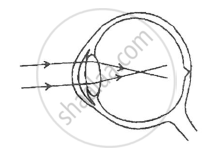
(i) Name the defect shown in the diagram.
(ii) What are the two possible that cause this defect?
(iii) Name the type of lens used to correct this defect.
(iv) With the help of a diagram show how the defect shown above is rectified using a suitable lens.
Advertisements
उत्तर
(i) Myopia
(ii) Two possible reasons are
- Eye ball is lengthened from front to back.
- Lens is too curved.
(iii) Concave lens
(iv)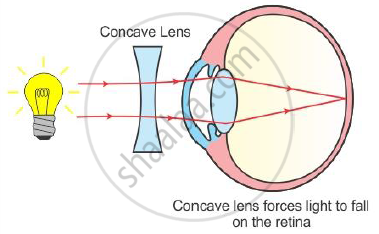
APPEARS IN
संबंधित प्रश्न
- Draw a well-labelled diagram of the membranous labyrinth found in the inner ear.
- Based on the diagram drawn above in (i), give a suitable term for each of the following descriptions:
- The sensory cells that help in hearing.
- The part that is responsible for static balance of the body.
- The membrane-covered opening that connects the middle ear to the inner ear.
- The fluid present in the middle chamber of cochlea.
- The structure that maintains dynamic equilibrium of the body.
Give technical terms for The nerve which transmits impulses from the ear to the brain
Give biological explanations for We should not put sharp objects into our ears.
Mention the exact location of the following :
Incus
Name the nerve which carries electrical impulses from the cochlea of ear to the brain.
The figure below is the sectional view of a part of the skull showing a sense organ:
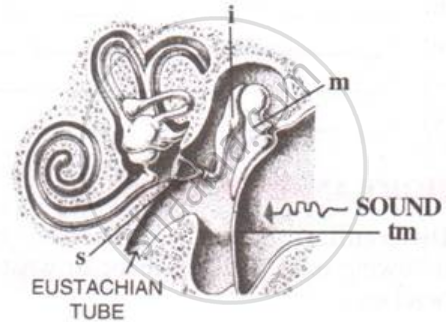
What do you call the part shown in the form of a spiral? What is its function?
Draw a labeled diagram of the inner ear. Name the part of the inner ear that is responsible for static balance in human beings.
State the Function:
Endolymph
Given below is a diagrammatic representation of a part of the human ear.
- Name the parts numbered 1-6.
- Which parts of the ear shown here are complete.
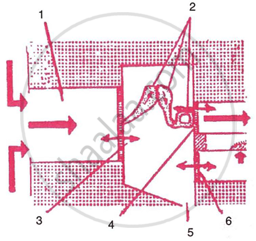 |
Note the relationship between the first two words and suggest the suitable word/words for the fourth place.
Ears: Auditory nerve :: Eyes : ______.
