मराठी

Choose the Odd One Out: Semicircular Canals, Cochlea, Tympanum, Utriculus. - Biology

Advertisements
Advertisements

प्रश्न

 Choose the Odd One Out: 

पर्याय

  • Semicircular canals

  • cochlea

  • Tympanum

  • Utriculus

MCQ
Advertisements

उत्तर

Tympanum

shaalaa.com
  या प्रश्नात किंवा उत्तरात काही त्रुटी आहे का?
पाठ 8: The Nervous System and Sense Organs - Choose the Odd One Out

APPEARS IN

आईसीएसई Biology [English] Class 10
पाठ 8 The Nervous System and Sense Organs
Choose the Odd One Out | Q 15

संबंधित प्रश्‍न

find odd one from following: Malleus, iris, Stapes, Incus.


Given below is a diagram depicting a defect of the human eye, study the same and then answer the questions that follow:

(i) Name the defect shown in the diagram.
(ii) What are the two possible that cause this defect?
(iii) Name the type of lens used to correct this defect.
(iv) With the help of a diagram show how the defect shown above is rectified using a suitable lens.


Given in the box below are a set of 14 biological terms. Of these, 12 can be paired into 6 matching pairs. Out of the six pairs, one has been done for you as an example. 
Example : endosmosis - Turgid cell.
Identify the remaining five matching pairs :

Cushing’s syndrome, Turgid cell, Iris, Free of rod and cone cells, Colour of eyes, Hypoglycemia, Active transport, Acrosome, Addison’s disease, Blind spot, Hyperglycemia, Spermatozoa, Endosmosis, Clotting of blood.


fill in the blanks with suitable functions: Ciliary body and __________.


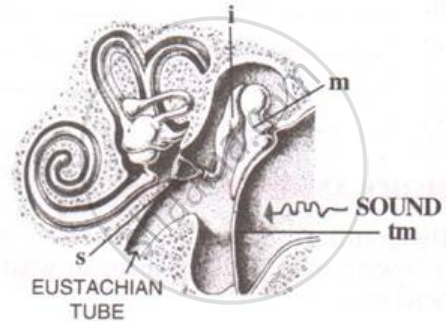
The ear ossicle which is attached to the tympanum.


Differentiate between members of the following pair with reference to what is asked in bracket.

Semi-circular canal and cochlea (Senses perceived)


Where is the Utriculus located? Briefly mention its function.


Name the tube which connects the middle ear to throat.


The following diagram refers to the ear of a mammal.

(i) Label the parts 1 to 10 to which the guidelines point.
(ii) Which structure:
(a) converts sound waves into mechanical vibrations?
(b) Converts vibrations into nerve impulses?
(c) Responds to change in position?
(d) Transmits impulses to the brain?
(e) Equalizes atmospheric pressure and pressure in the ear.


Give reason:

Three small bones of ear ossicles are advantageous as compared to one single bone for hearing.


Share
Notifications

Englishहिंदीमराठी


      Forgot password?
Use app×