Advertisements
Advertisements
प्रश्न
The figure below is the sectional view of a part of the skull showing s sense organ:
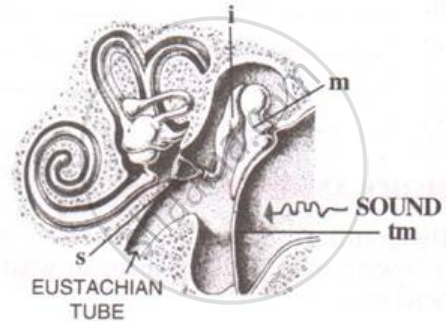
Name the sense organ.
Advertisements
उत्तर
Ear
संबंधित प्रश्न
Lightning and thunder take place in the sky at the same time and at the same distance from us. Lightning is seen earlier and thunder is heard later. Can you explain?
Give technical terms for The nerve which transmits impulses from the ear to the brain
Mention, where in living organism is the following located and state their main function:
Organ of corti
Mention if the following statement is true (T) or false (F) Give reason.
Malleus incus and stapes are collectively called the ear ossicles.
The diagram alongside represents the structure found in the inner ear. Study the same and then answer the questions that follow:
(i) Name the parts labelled A, B, C and D.
(ii) Name the parts of the ear responsible for transmitting impulses to the brain.
(iii) Name the part labelled above which is responsible for:
1. Static equilibrium. 2. Dynamic equilibrium. 3. Hearing
(iv) Name the audio receptor cells which pick up vibrations.
(v) Name the fluid present in the inner ear.

Write whether the following is true or false:
Vitreous chamber is present in ear in humans.
Given below is a diagram of a part of the human ear. Study the same and answer the question that follow:
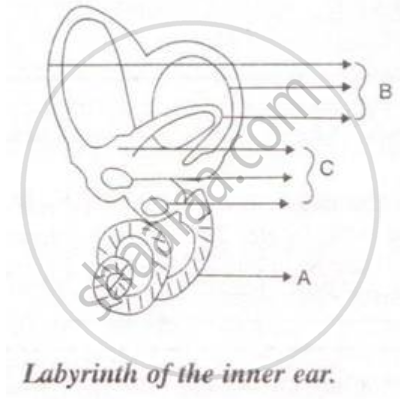
State the functions of the parts labeled 'A' and 'B'.
State the Function:
Endolymph
Choose the Odd One Out:
The part of the inner ear which is responsible for hearing is ______.
