Advertisements
Advertisements
प्रश्न
What is a reflex action?
What is meant by Reflex action?
Advertisements
उत्तर
Reflex action is a sudden, spontaneous, automatic, involuntary response to a stimulus.
APPEARS IN
संबंधित प्रश्न
The diagram given below shows the internal structure of a spinal cord depicting a phenomena. Study the diagram and answer the questions:
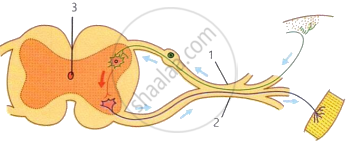
- Name the phenomenon that is depicted in the diagram. Define the phenomenon.
- Give the technical term for the point of contact between the two nerve cells.
- Name the parts numbered 1, 2 and 3.
- How does the arrangement of neurons in the spinal cord differ from that of the brain?
- Mention two ways by which the spinal cord is protected in our body.
If we happen to touch a hot object unknowingly, we immediately pull back our hand. What is this type of action known as?
When you smell a favourite food your mouth begins to water (that is, you secrete saliva). Write down what is the example of the cells in your nasal passages which perceive the smell?
Which of the following cannot be considered a receptor?
(a) ear
(b) nose
(c) muscle
(d) eye
Which of the following are cerebral reflexes?
(i) a person pulls away his hand on touching a hot object
(ii) a person spits out immediately when a fly enters his mouth while talking
(iii) A person walking bare foot lifts his foot at once on stepping on to a nail
(iv) A person's pupil contracts at once in the presence of bright light
(a) (i) and (ii) (b) (ii) and (iii) (c) (iii) and (iv) (d) (ii) and (iv)
The part of brain which controls the involuntary action such as heart beat, breathing, blood pressure, etc. is :
(a) pons
(b) medulla
(c) cerebrum
(d) cerebellum
Define voluntary and reflex actions. Give examples of each.
what do we refer to in the nervous system when we say:
Natural and conditioned …………………
State whether the following is simple reflex, conditioned reflex or neither of the two:
Knitting without looking: …………………..
What is the difference between reflex action and voluntary action?
Give one example of a conditioned reflex in your own life.
State whether the following is simple reflex, conditioned reflex or neither of the two.
Knitting without looking
Complete the following sentence with appropriate Word
The control of reflex action is through:
A change in the environment that causes an animal to react is called ______.
What will you do if someone pricks your hand with a needle? Elucidate the pathway of response with a neat labelled diagram.
Reflex actions are mediated through ____________.
Which of the following is not an involuntary action?
The given diagrammatic representation of reflex action shows knee jerk reflex.

Identify the parts labeled as A to E and select the correct option.
How is the mode of action in beating of the heart different from reflex actions? Give four examples.
