Advertisements
Advertisements
प्रश्न
The diagram given below shows the internal structure of a spinal cord depicting a phenomena. Study the diagram and answer the questions:
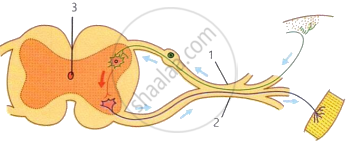
- Name the phenomenon that is depicted in the diagram. Define the phenomenon.
- Give the technical term for the point of contact between the two nerve cells.
- Name the parts numbered 1, 2 and 3.
- How does the arrangement of neurons in the spinal cord differ from that of the brain?
- Mention two ways by which the spinal cord is protected in our body.
Advertisements
उत्तर
- The phenomenon shown in the figure is a spinal reflex.
Spinal reflex is an automatic/quick/immediate, involuntary action in the body brought about by a stimulus. - Synapse
- 1: Sensory neuron
2: Motor neuron
3: Grey matter with the central canal of the spinal cord - The grey matter is present in the cortex (outer side) consisting of cell bodies and white matter is present inside, which consists of myelinated axons in the brain. In the spinal cord, the grey matter (cell bodies) are present inside, while white matter (Myelinated axon) is present outside.
- The spinal cord is protected in our body by the vertebral column, meninges and cerebrospinal fluid (CSF).
संबंधित प्रश्न
State whether coughing is a voluntary action or reflex action.
Our ______ system allows us to react to our surroundings. Information from receptors passes along ______ neurons to our brain. Our brain sends impulses along ______ neurons to our muscles.
Which of the following are cerebral reflexes?
(i) a person pulls away his hand on touching a hot object
(ii) a person spits out immediately when a fly enters his mouth while talking
(iii) A person walking bare foot lifts his foot at once on stepping on to a nail
(iv) A person's pupil contracts at once in the presence of bright light
(a) (i) and (ii) (b) (ii) and (iii) (c) (iii) and (iv) (d) (ii) and (iv)
One of the following gives the correct sequence of the components in a reflex arc. This is:
A cylindrical structure P in our body begins in continuation with medulla and extends downwards. It is enclosed in a bony cage Q and surrounded by membranes R. As many as x pairs of nerves arise from the structure P. The structure P is involved in the reflex actions of our body and conduction of nerve impulses to and from another organ S of our body with which it forms CNS.
(a) Name the structure P.
(b) Name (i) bony cage Q, and (ii) membranes R.
(c) How much is x?
(d) Name the organs S.
(e) What are the reflexes involving structure P only known as?
Complete the following statement by choosing the correct alternative from the choice given in bracker:
Reflex action is controlled by
(i) brain (ii) spinal cord
(iii) autonomic (iii) peripheral nervous system
State whether the following is simple reflex, conditioned reflex or neither of the two.
Sudden application of brakes of the cycle on sighting an obstacle in front
Categorise the following under stimulus and response.
Withdrawal of hand on touching a hot plate
Categorise the following under stimulus and response.
Pain in the eye if something falls into it.
State whether the following is simple reflex, conditioned reflex or neither of the two.
Sneezing
