Advertisements
Advertisements
Question
The diagram given below shows the internal structure of a spinal cord depicting a phenomena. Study the diagram and answer the questions:
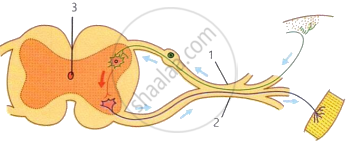
- Name the phenomenon that is depicted in the diagram. Define the phenomenon.
- Give the technical term for the point of contact between the two nerve cells.
- Name the parts numbered 1, 2 and 3.
- How does the arrangement of neurons in the spinal cord differ from that of the brain?
- Mention two ways by which the spinal cord is protected in our body.
Advertisements
Solution
- The phenomenon shown in the figure is a spinal reflex.
Spinal reflex is an automatic/quick/immediate, involuntary action in the body brought about by a stimulus. - Synapse
- 1: Sensory neuron
2: Motor neuron
3: Grey matter with the central canal of the spinal cord - The grey matter is present in the cortex (outer side) consisting of cell bodies and white matter is present inside, which consists of myelinated axons in the brain. In the spinal cord, the grey matter (cell bodies) are present inside, while white matter (Myelinated axon) is present outside.
- The spinal cord is protected in our body by the vertebral column, meninges and cerebrospinal fluid (CSF).
RELATED QUESTIONS
What is the role of the brain in reflex action?
Briefly explain the following terms : Reflex action
Which part of the eye contains cells which are sensitive to light?
When you smell a favourite food your mouth begins to water (that is, you secrete saliva). Write down what is the example of the cells in your nasal passages which perceive the smell?
Which of the following helps in maintaining posture and balance of the human body?
One of the following gives the correct sequence of the components in a reflex arc. This is:
The olfactory receptors in humans are located in :
(a) eyes
(b) tongue
(c) ears
(d) nose
Give one example of a conditioned reflex in your own life.
What type of reflex is the following?
Solving mathematical sums
Mention, if the following statement is True or False
Reflex action involves brain
