Advertisements
Advertisements
Question
A student has difficulty reading the blackboard while sitting in the last row. What could be the defect the child is suffering from? How can it be corrected?
Advertisements
Solution
A student has difficulty in reading the blackboard while sitting in the last row. It shows that he is unable to see distant objects clearly. He is suffering from myopia. This defect can be corrected by using a concave lens.
APPEARS IN
RELATED QUESTIONS
About 45 lac people in the developing countries are suffering from corneal blindness. About 30 lac children below the age of 12 years suffering from this defect can be cured by replacing the defective cornea with the cornea of a donated eye. How and why can students of your age involve themselves to create awareness about this fact among people?
Explain two possible reasons of myopia. How can it be corrected? Explain with a suitable diagram.
A student is unable to see clearly the words written on the black board placed at a distance of approximately 3 m from him. Name the defect of vision the boy is suffering from. State the possible causes of this defect and explain the method of correcting it.
Name the defect of vision in a person:
whose far point is less than infinity
Which defect of vision can be rectified:
by using a concave lens?
Which defect of vision can be rectified:
by using a convex lens?
A man can read the number of a distant but clearly but he finds difficulty in reading a book.
What type of spectacle lens should he use to correct the defect?
Name the following:
The eye defect caused due to shortening of the eye ball from front to back.
A person is unable to read a book placed closer than 1 meter from his eyes. Identify the defect of vision in his eyes. Draw the ray diagrams to show the defect of vision and its correction.
State the main functions of the following:
Tears
Given below is a diagram depicting a defect of the human eye? Study the same and answer the question that follow:
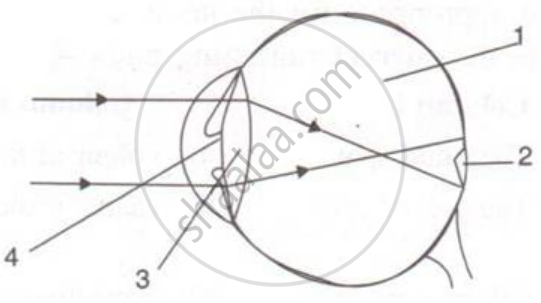
Give two possible reasons for this defect of the eye in human beings.
In what two whys is a yellow spot different from the blind spot?
Name the common defects of the eye.
Name an old age eye defect. Why is it caused?
Give Reason:
When you enter into a dark room from bright because of sunlight, you can not see things for a few seconds.
Give Technical Term:
The path which responsible for protecting the eye from sweat.
With respect to human eye explain:
(i) How is the image formed on the retina?
(ii) How is the amount of light entering the eye-controlled?
(iii) What type of lens is used for the correction of ‘Long sight’ defect?
(iv) With the help of a ray, diagram show the defect of the eye and then its correction after the use of a lens.
Write scientific reason.
Nearsightedness, this defect can be corrected by using spectacles with concave lens.
Assertion: Myopia is the defect of vision in which a person cannot see distant objects clearly.
Reason: This due to eye-ball being too short.
A teacher drew the diagram of the heart on the blackboard and told the students to copy it in their notebooks. Mahesh couldn't see the diagram clearly as it appeared blurred to him.
- Name the defect of the eye Mahesh is suffering from.
- Where is the image formed in this defect?
- Mahesh consults an eye doctor and is prescribed suitable lenses to correct the defect. Which type of lens do his spectacles have?
