Advertisements
Advertisements
Question
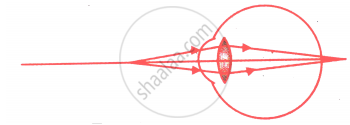
Given below is a diagram showing a defect of vision. Name the defect of vision and draw an accurately labelled diagram to correct this defect.
Advertisements
Solution
Name of defect: Farsightedness or hypermetropia
Correction of Farsightedness:

APPEARS IN
RELATED QUESTIONS
Given below is a diagram showing a defect of human eye. Study it and answer the following questions.

(i) Name the defect shown in the figure.
(ii) Give reason for this defect of eye in human being.
(iii) Name the type of lens used to correct the eye defect.
What is myopia?
The far point of a myopic person is 80 cm in front of the eye. What is the nature and power of the lens required to correct the problem?
What is the far point of a person suffering from myopia (or short-sightedness)?
Your friend can read a book perfectly well but cannot read the writing on blackboard unless she sits on the front row in class.
What type of lenses-converging or diverging-would an optician prescribe for her?
A man can read the number of a distant bus clearly but he finds difficulty in reading a book.
- From which defect of the eye is he suffering?
- What type of spectacle lens should he use to correct the defect?
A man can read the number of a distant but clearly but he finds difficulty in reading a book.
What type of spectacle lens should he use to correct the defect?
A student sitting in the last row of the class-room is not able to read clearly the writing on the blackboard.
- Name the type of defect he is suffering from.
- How can this defect by corrected?
A person having short-sight cannot see objects clearly beyond a distance of 1.5 m. What would be the nature and power of the corrective lens to restore proper vision?
An eye has a near point distance of 0.75 m. What sort of lens in spectacles would be needed to reduce the near point distance to 0.25 m? Also calculate the power of lens required. Is this eye long-sighted or short-sighted?
An eye has a far point of 2 m. What type of lens in spectacles would be needed to increase the far point to infinity? Also calculate the power of lens required. Is this eye long-sighted or short-sighted?
Though a woman can see the distant object clearly, she cannot see the nearby objects clearly. She is suffering from the defect of vision called:
(a) long-sight
(b) short-sight
(c) hind-sight
(d) mid-sight
A person can read a book clearly only if he holds it at an arm's length from him. Name the defect of vision:
if the person is a young man
Which part of the eye is grafted in a needy patient from a donated eye?
Differentiate between members of the following pair with reference to what is asked in bracket.
Myopia and hyperopia (cause of the defect)
By closing the eyes and gently pressing them by your palms, you may see some specks of brilliant light. How do you get this sensation while there is no light entering your eyes?
Explain the terms ‘adaptation’ and ‘accommodation’ with reference to the eye.
You do not enjoy watching a movie from a very short distance from the screen in a cinema hall. Why?
A student cannot see a chart hanging on a wall placed at a distance of 3 m from him. Name the defect of vision he is suffering from. How can it be corrected? Draw ray diagrams for the (i) defect of vision and also (ii) for its correction.
State the main functions of the following:
Tears
Given alongside is a diagram depicting a defect of the human eye. Study the same and then answer the questions that follow:
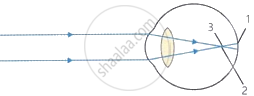
- Identify the defect.
- Name the parts labelled 1, 2 and 3.
- Give two possible reasons for this eye defect.
- Draw a labelled diagram to show how the above mentioned defect is rectified.
The diagram alongside represents a section of a mammalian eye.
(i) Label the parts 1 to 5 of the diagram.
(ii) State the function of the parts labelled 4 and 5.
(iii) With the help of a diagram show the short sightedness.

In what two whys is a yellow spot different from the blind spot?
Name the common defects of the eye.
Give Reason:
Deficiency of vitamin A causes night blindness.
Differentiate between:
Myopia and Hypermetropia.
Explain the Term: Astigmatism
What type of lens is used to correct Astigmatism?
What type of lens is used to correct Hypermetropia?
The diagram given below represents the cross-section of the human eye:

(i) Name the parts labeled 1—12.
(ii) What is the function of the part marked ‘10’?
(iii) What would happen if part ‘5’ is damaged or cut?
Choose the Odd One Out:
Write scientific reason.
Nearsightedness, this defect can be corrected by using spectacles with concave lens.
Which of the following statement is correct?
Draw ray diagram showing myopic eye.
A student sitting at the back of the classroom cannot read clearly the letters written on the blackboard. What advice will a doctor give to her? Draw ray diagram for the correction of this defect.
A person needs a lens of power –4.5 D for correction of her vision.
- What kind of defect in vision is she suffering from?
- What is the focal length of the corrective lens?
- What is the nature of the corrective lens?
Observe the following diagram and answer questions following it:

- Identify the defect of vision shown.
- List its two causes.
- Name the type of lens used for the correction of this defect.
Complete the following table by observing the given figures:
| Figure → |  |
 |
| Points ↓ | ||
| (a) Name of the defect | ______ | ______ |
| (b) Position of the image | ______ | ______ |
| (c) Lens used to correct the defect | ______ | ______ |
A teacher drew the diagram of the heart on the blackboard and told the students to copy it in their notebooks. Mahesh couldn't see the diagram clearly as it appeared blurred to him.
- Name the defect of the eye Mahesh is suffering from.
- Where is the image formed in this defect?
- Mahesh consults an eye doctor and is prescribed suitable lenses to correct the defect. Which type of lens do his spectacles have?
