Advertisements
Advertisements
Question
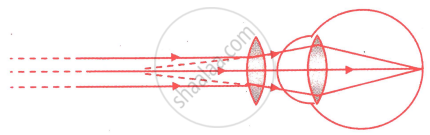
Observe the given below the figure, correct it and explain and write about the concept depicted in this figure.
Advertisements
Solution
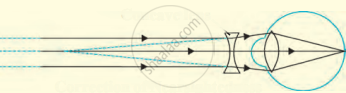
The figure shows a myopic eye, in which the eye lens is unable to focus the light rays coming from distant object onto the retina. In this defect, the image of distant object is formed before the retina i.e., the light rays converge before they reach the retina. Hence, to correct this defect a diverging lens (concave lens) of proper focal length is used, so that, the rays reach the retina after refraction and the person can see the image clearly.
APPEARS IN
RELATED QUESTIONS
Do you know that the corneal-impairment can be cured by replacing the defective cornea with the cornea of the donated eye? How and why should we organise groups to motivate the community members to donate their eyes after death?
About 45 lac people in the developing countries are suffering from corneal blindness. About 30 lac children below the age of 12 years suffering from this defect can be cured by replacing the defective cornea with the cornea of a donated eye. How and why can students of your age involve themselves to create awareness about this fact among people?
The far point of a myopic person is 80 cm in front of the eye. What is the nature and power of the lens required to correct the problem?
Name the defect of vision in a person:
whose near point is more than 25 on away.
Name the defect of vision which makes the eye-lens cloudy resulting in blurred vision.
A man can read the number of a distant but clearly but he finds difficulty in reading a book.
What type of spectacle lens should he use to correct the defect?
What are the two most common defects of vision (or defects of eye)? How are they corrected?
Differentiate between myopia and hypermetropia.
A person suffering from the eye-defect myopia (short-sightedness) can see clearly only up to a distance of 2 metres. What is the nature and power of lens required to rectify this defect?
What is short-sightedness? State the two causes of short-sightedness (or myopia). With the help of ray diagrams, show:
(i) the eye-defect short-sightedness.
(ii) correction of short-sightedness by using a lens.
A person having short-sight cannot see objects clearly beyond a distance of 1.5 m. What would be the nature and power of the corrective lens to restore proper vision?
An eye has a near point distance of 0.75 m. What sort of lens in spectacles would be needed to reduce the near point distance to 0.25 m? Also calculate the power of lens required. Is this eye long-sighted or short-sighted?
The defect of vision which cannot be corrected by using spectacles is:
(a) myopia
(b) presbyopia
(c) cataract
(d) hypermetropia
The defect of vision in which the eye-lens of a person gets progressively cloudy resulting in blurred vision is called:
(a) myopia
(b) presbyopia
(c) colourblindness
(d) cataract
To read a book held at a distance of 25 cm, will she need converging or diverging spectacle lenses?
Name the following:
The eye defect caused due to shortening of the eye ball from front to back.
What is meant by optical illusion? Give one example.
Enumerate the common defects of vision, their causes and the possible methods of correcting them.
An old man cannot see objects closer than 1 m from the eye clearly. Name the defect of vision he is suffering from. How can it be corrected? Draw ray diagram for the (i) defect of vision and also (ii) for its correction.
Draw a ray diagram to show how Hypermetropia is defect can be corrected using a lens.
Name the following:
The photosensitive pigment present in the rod cells of the retina.
Write whether the following is true or false:
A convex lens is used for correcting myopia.
Given alongside is a diagram depicting a defect of the human eye. Study the same and then answer the questions that follow:
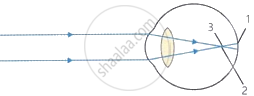
- Identify the defect.
- Name the parts labelled 1, 2 and 3.
- Give two possible reasons for this eye defect.
- Draw a labelled diagram to show how the above mentioned defect is rectified.
Rewrite the following table so as to match second and third column with first column.
|
Column I
|
Column II
|
Column III
|
|
(i) Myopia
|
Old age problem
|
Bifocal lens
|
|
(ii) Presbyopia
|
Nearsightedness
|
Concave lens.
|
Anuja cannot see the blackboard writing but she can see nearby things.
(a) What is the eye defect she is suffering from?
(b) State the possible reason for her defect.
(c) How is it corrected
The near point of the eye of a person is 50 cm. Find the nature and power of the corrective lens required by the person to enable him to see clearly the objects placed at 25 cm from the eye?
A person is unable to see objects distinctly placed within 50 cm from his eyes.
(a) Name the defect of vision the person is suffering from and list its two possible causes.
(b) Draw a ray diagram to show the defect in the above case.
(c) Mention the type of lens used by him for the correction of the defect and calculate its power. Assume that the near point for the normal eye is 25 cm.
(d) Draw a labeled diagram for the correction of the defect in the above case.
In what two whys is a yellow spot different from the blind spot?
Name an old age eye defect. Why is it caused?
The diagram given below represents the cross-section of the human eye:

(i) Name the parts labeled 1—12.
(ii) What is the function of the part marked ‘10’?
(iii) What would happen if part ‘5’ is damaged or cut?
With respect to human eye explain:
(i) How is the image formed on the retina?
(ii) How is the amount of light entering the eye-controlled?
(iii) What type of lens is used for the correction of ‘Long sight’ defect?
(iv) With the help of a ray, diagram show the defect of the eye and then its correction after the use of a lens.
Mention, if the following statement is True or False
Hypermetropia is a defect of the eye caused due to the eyeball elongation
Choose the Odd One Out:
Due to elongation of _______ and increase in curvature of the eye lens, a person cannot see distant objects clearly.
Assertion: Concave mirrors are used as reflectors in torches, vehicle head lights and in search lights.
Reason: When an object is placed beyond the center of curvature of a concave mirror, the image formed is real and inverted.
A student sitting at the back of the classroom cannot read clearly the letters written on the blackboard. What advice will a doctor give to her? Draw ray diagram for the correction of this defect.
Complete the following table by observing the given figures:
| Figure → |  |
 |
| Points ↓ | ||
| (a) Name of the defect | ______ | ______ |
| (b) Position of the image | ______ | ______ |
| (c) Lens used to correct the defect | ______ | ______ |
