English

When do we consider a person to be myopic or hypermetropic? Explain using diagrams how the defects associated with myopic and hypermetropic eye can be corrected? - Science

Advertisements
Advertisements

Question

When do we consider a person to be myopic or hypermetropic? Explain using diagrams how the defects associated with myopic and hypermetropic eye can be corrected?

Long Answer
Advertisements

Solution

  • Myopia : When a person can see nearby objects clearly but cannot see distant objects distinctly then the person is suffering from myopia. A person with this defect has the far point nearer than infinity. Myopia is also known as near-sightedness. 

                                                                   Myopia eye   
  • Correction of Myopia :  Wearing of concave lens diverges the light rays to help the image to be focused on the retina, hence myopia is corrected using the concave lens of suitable focal length.
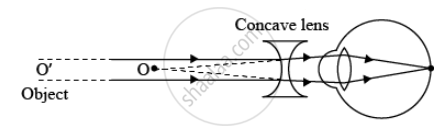
                                    Correction for Myopia
  • Hypermetropia: When a person can see distant objects clearly but cannot see nearby objects distinctly, then the person is suffering from hypermetropia. The near point, for the person, is farther away from the normal near point (25 cm). Hypermetropia is also known as far-sightedness.

                                                           Hypermetropic eye
  • Correction of hypermetropia : Wearing a convex lens in front of a hypermetropic eye converges the light rays to help the image to be focused on the retina, hence this defect is corrected using the convex lens of suitable focal length.
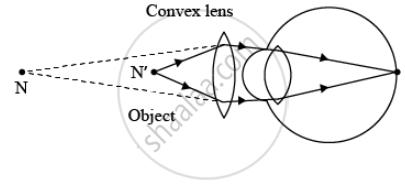
                         Correction of hypermetropia eye  
     
shaalaa.com
  Is there an error in this question or solution?
Chapter 11: The Human Eye and the Colourful World - Long Answer Questions [Page 89]

APPEARS IN

NCERT Exemplar Science [English] Class 10
Chapter 11 The Human Eye and the Colourful World
Long Answer Questions | Q 26. | Page 89

Video TutorialsVIEW ALL [1]

RELATED QUESTIONS

Millions of people in the developing countries of the world are suffering from corneal blindness. These persons can be cured by replacing the defective cornea with the cornea of a donated eye. A charitable society of your city has organised a campaign in your neighbourhood in order to create awareness about this fact. If you are asked to participate in this mission, how would you contribute in this noble cause?

(i) State the objective of organising such campaigns.

(ii) List two arguments which you would give to motivate the people to donate their eyes after death.

(iii) List two values which are developed in the persons who actively participate and contribute in such programmes.


A student is unable to see clearly the words written on the blackboard placed at a distance of approximately 4 m from him. Name the defect of vision the boy is suffering from. Explain the method of correcting this defect.

Draw ray diagram for the:-

(i) defect of vision and also

(ii) for its correction.


What is the other name for 

 hypermetropia


A man can read the number of a distant but clearly but he finds difficulty in reading a book.  

What type of spectacle lens should he use to correct the  defect?


Explain with the help of labelled ray diagram, the defect of vision called myopia and how it is corrected by a lens.


A person suffering from the eye-defect myopia (short-sightedness) can see clearly only up to a distance of 2 metres. What is the nature and power of lens required to rectify this defect?


An eye has a far point of 2 m. What type of lens in spectacles would be needed to increase the far point to infinity?  Also calculate the power of lens required. Is this eye long-sighted or short-sighted?


To read a book held at a distance of 25 cm, will she need converging or diverging spectacle lenses?


Have a look at the posture of this girl who is reading a book and answer the questions which follow:

Name the problem she is facing.


List two causes of presbyopia. Draw labelled diagram of a lens used for the correction of this defect of vision. 


Name the following:
The photosensitive pigment present in the rod cells of the retina.


Have a look at the posture of this woman who is reading a book and answer the questions which follow:

What kind of looking glasses she needs?


Explain the Term: Hypermetropia


Explain the Term: Astigmatism


Due to elongation of _______ and increase in curvature of the eye lens, a person cannot see distant objects clearly.


Myopia and hypermetropia can be corrected by:


A person cannot see distinctly objects kept beyond 2 m. This defect can be corrected by using a lens of power:


Which of the following statement is correct?


A person needs a lens of power –4.5 D for correction of her vision.

  1. What kind of defect in vision is she suffering from?
  2. What is the focal length of the corrective lens?
  3. What is the nature of the corrective lens?

Observe the figure whether it is correct or not and explain the phenomenon.


Share
Notifications

Englishहिंदीमराठी


      Forgot password?
Use app×