Advertisements
Advertisements
प्रश्न
When do we consider a person to be myopic or hypermetropic? Explain using diagrams how the defects associated with myopic and hypermetropic eye can be corrected?
Advertisements
उत्तर
- Myopia : When a person can see nearby objects clearly but cannot see distant objects distinctly then the person is suffering from myopia. A person with this defect has the far point nearer than infinity. Myopia is also known as near-sightedness.

Myopia eye - Correction of Myopia : Wearing of concave lens diverges the light rays to help the image to be focused on the retina, hence myopia is corrected using the concave lens of suitable focal length.
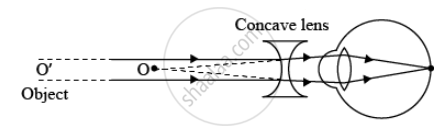
Correction for Myopia - Hypermetropia: When a person can see distant objects clearly but cannot see nearby objects distinctly, then the person is suffering from hypermetropia. The near point, for the person, is farther away from the normal near point (25 cm). Hypermetropia is also known as far-sightedness.

Hypermetropic eye - Correction of hypermetropia : Wearing a convex lens in front of a hypermetropic eye converges the light rays to help the image to be focused on the retina, hence this defect is corrected using the convex lens of suitable focal length.
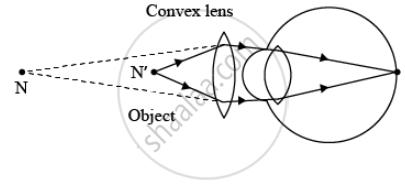
Correction of hypermetropia eye
APPEARS IN
संबंधित प्रश्न
About 45 lac people in the developing countries are suffering from corneal blindness. About 30 lac children below the age of 12 years suffering from this defect can be cured by replacing the defective cornea with the cornea of a donated eye. How and why can students of your age involve themselves to create awareness about this fact among people?
The far point of a myopic person is 80 cm in front of the eye. What is the nature and power of the lens required to correct the problem?
the biological/technical terms for the lens of eye losing flexibility resulting in a kind of long-sightedness in middle aged people.
Which defect of vision can be rectified:
by using a concave lens?
Name the defect of vision in which the eye-lens loses its power of accommodation due to old age.
Your friend can read a book perfectly well but cannot read the writing on blackboard unless she sits on the front row in class.
- Is she short-sighted or long-sighted?
- What type of lenses-converging or diverging-would an optician prescribe for her?
Your friend can read a book perfectly well but cannot read the writing on blackboard unless she sits on the front row in class.
What type of lenses-converging or diverging-would an optician prescribe for her?
A student sitting in the last row of the class-room is not able to read clearly the writing on the blackboard.
How can this defect by corrected?
What is long-sightedness? State the two causes of long-sightedness (or hypermetropia). With the help of ray diagrams, show:
(i) the eye-defect long-sightedness.
(ii) correction of long-sightedness by using a lens.
What is meant by optical illusion? Give one example.
Given below is a diagram depicting a defect of the human eye? Study the same and answer the question that follow :
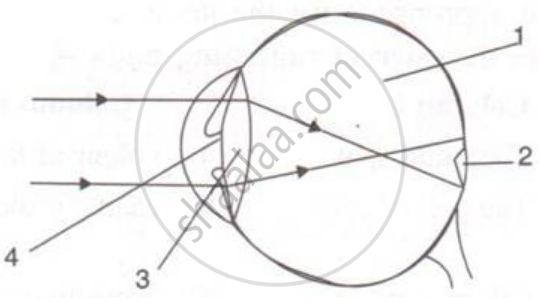
Name the type of lens used to correct this eye defect.
Given below is a diagram depicting a defect of the human eye? Study the same and answer the question that follow:

Draw a labeled diagram to show how the above mentioned defect is rectified using the lens named above.
The near point of the eye of a person is 50 cm. Find the nature and power of the corrective lens required by the person to enable him to see clearly the objects placed at 25 cm from the eye?
Name an old age eye defect. Why is it caused?
Explain the Term: Astigmatism
Write scientific reason.
Nearsightedness, this defect can be corrected by using spectacles with concave lens.
Observe the given below the figure, correct it and explain and write about the concept depicted in this figure.
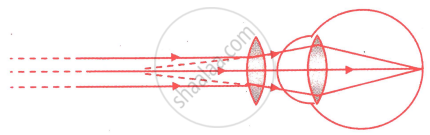
Observe the figure whether it is correct or not and explain the phenomenon.

Name the following:
Two kinds of accomodations.
Given alongside is a diagram depicting a defect of the human eye. Study the same and answer the questions that follow:
 |
- Name the defect shown in the diagram.
- Give two possible reasons for this defect.
- Name the parts labelled 1 to 4.
- Name the type of lens used to correct this eye defect.
- Draw a labelled diagram to show how the above mentioned defect is rectified using the lens named above.
