Advertisements
Advertisements
Question
In a Std. X class out of 40 students 10 students use spectacles, 2 students have positive power and 8 students have negative power of lenses in their spectacles.
Answer the following questions:
(1) What does the negative power indicate?
(2) What does the positive power indicate?
(3) Generally which type of spectacles do most of the students use?
(4) What defect of eyesight do most of the students suffer from?
(5) Give two possible reasons for the above defect.
Advertisements
Solution
(1) The negative power indicates that the spectacles used by the students have concave lens.
(2) The positive power indicates that the spectacles used by the students have convex lens.
(3) Diverging or concave lens spectacles are generally used by the students.
(4) Most of the students suffer from the eye defect known as myopia (near sightedness).
(5) The two possible reasons for the eye defect (myopia) are
- Converging power of the eye lens becomes high as ciliary muscles do not relax sufficiently.
- Length of the eye ball increases as the distance between the eye lens and the retina increases.
APPEARS IN
RELATED QUESTIONS
About 45 lac people in the developing countries are suffering from corneal blindness. About 30 lac children below the age of 12 years suffering from this defect can be cured by replacing the defective cornea with the cornea of a donated eye. How and why can students of your age involve themselves to create awareness about this fact among people?
What is the far point and near point of the human eye with normal vision?
The far point of a myopic person is 80 cm in front of the eye. What is the nature and power of the lens required to correct the problem?
What is the other name of old age hypermetropia?
Name one defect of vision (or eye) which cannot be corrected by any type of spectacle lenses.
A student sitting in the last row of the class-room is not able to read clearly the writing on the blackboard.
- Name the type of defect he is suffering from.
- How can this defect by corrected?
Explain with the help of labelled ray diagram, the defect of vision called myopia and how it is corrected by a lens.
The near-point of a person suffering from hypermetropia is at 50 cm from his eye. What is the nature and power of the lens needed to correct this defect? (Assume that the near-point of the normal eye is 25 cm).
The defect of vision which cannot be corrected by using spectacles is:
(a) myopia
(b) presbyopia
(c) cataract
(d) hypermetropia
A young man has to hold a book at arm's length to be able to read it clearly. The defect of vision is:
(a) astigmatism
(b) myopia
(c) presbyopia
(d) hypermetropia
The near point of a long-sighted person is 50 cm from the eye.
- Can she see clearly an object at:
- a distance of 20 cm?
- at infinity?
- To read a book held at a distance of 25 cm, will she need converging or diverging spectacle lenses?
A person can read a book clearly only if he holds it at an arm's length from him. Name the defect of vision:
if the person is a young man
Name the following:
The photosensitive pigment present in the rods of the retina.
Name the following:
The eye defect caused due to shortening of the eye ball from front to back.
Differentiate between members of the following pair with reference to what is asked in bracket.
Myopia and hyperopia (cause of the defect)
Name an old age eye defect. What happens in it?
Describe the mechanism of focusing the image of a distant object in your eye when you raise your head after reading a book.
A person is unable to read a book placed closer than 1 meter from his eyes. Identify the defect of vision in his eyes. Draw the ray diagrams to show the defect of vision and its correction.
An old man cannot see objects closer than 1 m from the eye clearly. Name the defect of vision he is suffering from. How can it be corrected? Draw ray diagram for the (i) defect of vision and also (ii) for its correction.
What eye defect is hypermetropia? Describe with a ray diagram how this defect of vision can be corrected by using an appropriate lens.
Observer the following diagram and answer the questions.
a) Which eye defect is shown in this diagram?
b) What are the possible reasons for this eye defect?
c) How this defect is corrected, write it in brief?

A student has difficulty reading the blackboard while sitting in the last row. What could be the defect the child is suffering from? How can it be corrected?
Given alongside is a diagram depicting a defect of the human eye. Study the same and then answer the questions that follow:
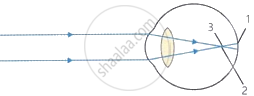
- Identify the defect.
- Name the parts labelled 1, 2 and 3.
- Give two possible reasons for this eye defect.
- Draw a labelled diagram to show how the above mentioned defect is rectified.
The diagram alongside represents a section of a mammalian eye.
(i) Label the parts 1 to 5 of the diagram.
(ii) State the function of the parts labelled 4 and 5.
(iii) With the help of a diagram show the short sightedness.

Explain the Term: Hypermetropia
Explain the Term: Cataract
What type of lens is used to correct Hypermetropia?
Given below is a diagrammatic representation of a defect of the human eye:

(i) Identify the defect.
(ii) Mention two reasons for the above defect.
(iii) State how the defect can be rectified.
(iv) Name the part of the eye responsible for maintaining the shape of the eyeball.
Mention, if the following statement is True or False
Hypermetropia is a defect of the eye caused due to the eyeball elongation
In Myopia the human eye _______.
Nearsightedness : concave lens : : farsightedness : _______
Write scientific reason.
Nearsightedness, this defect can be corrected by using spectacles with concave lens.
What are the causes of ‘Myopia’?
Differentiate the eye defects: Myopia and Hypermetropia
A person is unable to see clearly a poster fixed on a distant wall. He however sees it clearly when standing at a distance of about 2 m from the wall.
- Draw ray diagram to show the formation of image by his eye lens when he is far away from the wall.
- List two possible reasons of this defect of vision.
- Draw ray diagram to show the correction of this defect using appropriate lens.
Given alongside is a diagram depicting a defect of the human eye. Study the same and answer the questions that follow:
 |
- Name the defect shown in the diagram.
- Give two possible reasons for this defect.
- Name the parts labelled 1 to 4.
- Name the type of lens used to correct this eye defect.
- Draw a labelled diagram to show how the above mentioned defect is rectified using the lens named above.
