Advertisements
Advertisements
Question
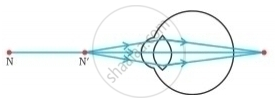
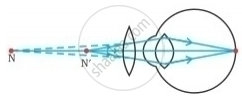
An old man cannot see objects closer than 1 m from the eye clearly. Name the defect of vision he is suffering from. How can it be corrected? Draw ray diagram for the (i) defect of vision and also (ii) for its correction.
Advertisements
Solution
The person is suffering from presbyopia. It is a common defect of vision, which generally occurs at old age. A person suffering from this type of defect of vision cannot see nearby objects clearly and distinctively. A presbyopic eye has its near point greater than 25 cm and it gradually increases as the eye becomes older. Presbyopia is caused by the
1. weakening of the ciliary muscles
2. reduction in the flexibility of the eye lens
This defect can be corrected by using a convex lens of appropriate power.
(i) Ray diagram showing presbyopia
(ii) Ray diagram showing correction of presbyopia
APPEARS IN
RELATED QUESTIONS
What is the scientific name of
short-sightedness
Name the defect of vision which makes the eye-lens cloudy resulting in blurred vision.
A short-sighted person has a near point of 15 cm and a far point of 40 cm.
(a) Can he see clearly an object at a distance of:
(i) 5 cm?
(ii) 25 cm?
(iii) 50 cm?
(b) To see clearly an object at infinity, what kind of spectacle lenses does he need?
Differentiate between members of the following pair with reference to what is asked in the bracket.
Rods and cones (sensitivity).
Enumerate the common defects of vision, their causes and the possible methods of correcting them.
State the main functions of the following:
Tears
In what two whys is a yellow spot different from the blind spot?
The diagram given below represents the cross-section of the human eye:

(i) Name the parts labeled 1—12.
(ii) What is the function of the part marked ‘10’?
(iii) What would happen if part ‘5’ is damaged or cut?
Due to elongation of _______ and increase in curvature of the eye lens, a person cannot see distant objects clearly.
Observe the figure whether it is correct or not and explain the phenomenon.

