Advertisements
Advertisements
प्रश्न
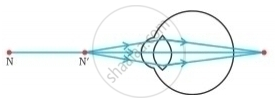
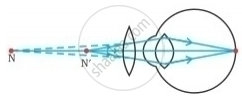
An old man cannot see objects closer than 1 m from the eye clearly. Name the defect of vision he is suffering from. How can it be corrected? Draw ray diagram for the (i) defect of vision and also (ii) for its correction.
Advertisements
उत्तर
The person is suffering from presbyopia. It is a common defect of vision, which generally occurs at old age. A person suffering from this type of defect of vision cannot see nearby objects clearly and distinctively. A presbyopic eye has its near point greater than 25 cm and it gradually increases as the eye becomes older. Presbyopia is caused by the
1. weakening of the ciliary muscles
2. reduction in the flexibility of the eye lens
This defect can be corrected by using a convex lens of appropriate power.
(i) Ray diagram showing presbyopia
(ii) Ray diagram showing correction of presbyopia
APPEARS IN
संबंधित प्रश्न
In a Std. X class out of 40 students 10 students use spectacles, 2 students have positive power and 8 students have negative power of lenses in their spectacles.
Answer the following questions:
(1) What does the negative power indicate?
(2) What does the positive power indicate?
(3) Generally which type of spectacles do most of the students use?
(4) What defect of eyesight do most of the students suffer from?
(5) Give two possible reasons for the above defect.
An eye has a far point of 2 m. What type of lens in spectacles would be needed to increase the far point to infinity? Also calculate the power of lens required. Is this eye long-sighted or short-sighted?
A person can read a book clearly only if he holds it at an arm's length from him. Name the defect of vision:
- if the person is an old man
- if the person is a young man
Draw a ray diagram to show how Hypermetropia is defect can be corrected using a lens.
State the main functions of the following:
Tears
Given below is a diagram depicting a defect of the human eye? Study the same and answer the question that follow :
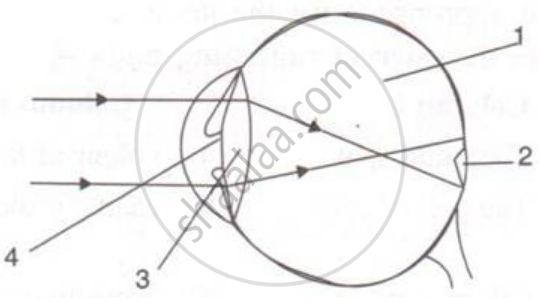
Name the type of lens used to correct this eye defect.
Have a look at the posture of this woman who is reading a book and answer the questions which follow:

What kind of looking glasses she needs?
Complete the following sentence with appropriate word :
An inability to focus on nearby objects due to loss of elasticity of the lens with age is called Iris.
Myopia may arise due to ____________.
Given alongside is a diagram depicting a defect of the human eye. Study the same and answer the questions that follow:
 |
- Name the defect shown in the diagram.
- Give two possible reasons for this defect.
- Name the parts labelled 1 to 4.
- Name the type of lens used to correct this eye defect.
- Draw a labelled diagram to show how the above mentioned defect is rectified using the lens named above.
