Advertisements
Advertisements
प्रश्न
In a Std. X class out of 40 students 10 students use spectacles, 2 students have positive power and 8 students have negative power of lenses in their spectacles.
Answer the following questions:
(1) What does the negative power indicate?
(2) What does the positive power indicate?
(3) Generally which type of spectacles do most of the students use?
(4) What defect of eyesight do most of the students suffer from?
(5) Give two possible reasons for the above defect.
Advertisements
उत्तर
(1) The negative power indicates that the spectacles used by the students have concave lens.
(2) The positive power indicates that the spectacles used by the students have convex lens.
(3) Diverging or concave lens spectacles are generally used by the students.
(4) Most of the students suffer from the eye defect known as myopia (near sightedness).
(5) The two possible reasons for the eye defect (myopia) are
- Converging power of the eye lens becomes high as ciliary muscles do not relax sufficiently.
- Length of the eye ball increases as the distance between the eye lens and the retina increases.
APPEARS IN
संबंधित प्रश्न
Write the importance of ciliary muscles in the human eye. Name the defect of vision that arises due to gradual weakening of the ciliary muscles. What types of lenses are required by the person suffering from this defect to see the objects clearly?
Akshay, sitting in the last row in his class, could not see clearly the words write on the blackboard. When the teacher noticed it, he announced if any student sitting in the front row could volunteer to exchange his seat with Akshay. Salman immediately agreed to exchange his seat with Akshay. He could now see the words written on the blackboard clearly. The teacher thought it fit to send the message to Akshay’s parents advising them to get his eyesight checked.
In the context of the above event, answer the following questions:-
(a) Which defect of vision is Akshay suffering from? Which type of lens is used to correct this defect?
(b) State the values displayed by the teacher and Salman.
(c) In your opinion, in what way can Akshay express his gratitude towards the teacher and Salman?
List three common refractive defects of vision. Suggest the way of correcting these defects.
Name the defect of vision in which the eye-lens loses its power of accommodation due to old age.
A man can read the number of a distant but clearly but he finds difficulty in reading a book.
What type of spectacle lens should he use to correct the defect?
A person suffering from the eye-defect myopia (short-sightedness) can see clearly only up to a distance of 2 metres. What is the nature and power of lens required to rectify this defect?
What is short-sightedness? State the two causes of short-sightedness (or myopia). With the help of ray diagrams, show:
(i) the eye-defect short-sightedness.
(ii) correction of short-sightedness by using a lens.
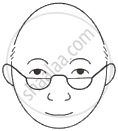
The picture given here shows a person wearing ‘half-moon’ spectacles. What sort of eye-defect do you think he has? Why are these particular spectacles useful to him?
A person can read a book clearly only if he holds it at an arm's length from him. Name the defect of vision:
- if the person is an old man
- if the person is a young man
Name the following:
The eye defect caused due to shortening of the eye ball from front to back.
Differentiate between members of the following pair with reference to what is asked in the bracket.
Rods and cones (sensitivity).
Describe the mechanism of focusing the image of a distant object in your eye when you raise your head after reading a book.
You do not enjoy watching a movie from a very short distance from the screen in a cinema hall. Why?
What eye defect is hypermetropia? Describe with a ray diagram how this defect of vision can be corrected by using an appropriate lens.
What is Hypermetropia (far sightedness)?
Observer the following diagram and answer the questions.
a) Which eye defect is shown in this diagram?
b) What are the possible reasons for this eye defect?
c) How this defect is corrected, write it in brief?

Choose the odd one out from the following terms and name the category to which the others belong.
Endolymph, Tympanic membrane, Semi-circular canal, Blind spot
Write whether the following is true or false:
A convex lens is used for correcting myopia.
Given below is a diagram depicting a defect of the human eye? Study the same and answer the question that follow:
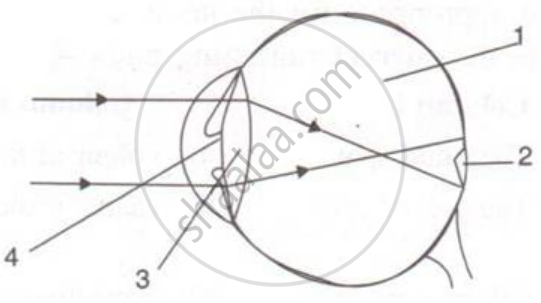
Give two possible reasons for this defect of the eye in human beings.
Have a look at the posture of this woman who is reading a book and answer the questions which follow:

What are the two conditions shown in sections A and B of the eye as applicable to her?
Have a look at the posture of this woman who is reading a book and answer the questions which follow:

What kind of looking glasses she needs?
Name the common defects of the eye.
Name an old age eye defect. Why is it caused?
Give Reason:
Deficiency of vitamin A causes night blindness.
The diagram given below represents the cross-section of the human eye:

(i) Name the parts labeled 1—12.
(ii) What is the function of the part marked ‘10’?
(iii) What would happen if part ‘5’ is damaged or cut?
With respect to human eye explain:
(i) How is the image formed on the retina?
(ii) How is the amount of light entering the eye-controlled?
(iii) What type of lens is used for the correction of ‘Long sight’ defect?
(iv) With the help of a ray, diagram show the defect of the eye and then its correction after the use of a lens.
Choose the Odd One Out:
In Myopia the human eye _______.
Nearsightedness : concave lens : : farsightedness : _______
Write scientific reason.
Nearsightedness, this defect can be corrected by using spectacles with concave lens.
Differentiate the eye defects: Myopia and Hypermetropia
Assertion: Concave mirrors are used as reflectors in torches, vehicle head lights and in search lights.
Reason: When an object is placed beyond the center of curvature of a concave mirror, the image formed is real and inverted.
Myopia may arise due to ____________.
Correlate the given sequence:
Hypermetropia : Convex lens : ______ : Concave lens
Observe the figure and answer the following questions:

- Name the defect of vision represented in the above figure.
- State the reasons for this defect.
- How is it corrected?
- Draw the diagram to show the correction of this defect.
Observe the following diagram and answer questions following it:

- Identify the defect of vision shown.
- List its two causes.
- Name the type of lens used for the correction of this defect.
Given alongside is a diagram depicting a defect of the human eye. Study the same and answer the questions that follow:
 |
- Name the defect shown in the diagram.
- Give two possible reasons for this defect.
- Name the parts labelled 1 to 4.
- Name the type of lens used to correct this eye defect.
- Draw a labelled diagram to show how the above mentioned defect is rectified using the lens named above.
