Advertisements
Advertisements
प्रश्न
What is short-sightedness? State the two causes of short-sightedness (or myopia). With the help of ray diagrams, show:
(i) the eye-defect short-sightedness.
(ii) correction of short-sightedness by using a lens.
Advertisements
उत्तर
Short-sightedness, or near-sightedness, is an eye defect because of which a person cannot see distant objects clearly but has normal near vision. Short-sightedness occurs because of the high converging power of the eye lens (images are formed in front of the retina) and because the eyeball is too long (images are formed in front of the retina).
(i) and (ii) The following diagram illustrates short-sightedness and how concave lenses can correct the defect by diverging the light rays entering the eye to form clear images of distant objects on the retina.

APPEARS IN
संबंधित प्रश्न
Explain two possible reasons of myopia. How can it be corrected? Explain with a suitable diagram.
Which defect of vision can be rectified:
by using a convex lens?
What is the other name for
hypermetropia
Name the defect of vision which makes the eye-lens cloudy resulting in blurred vision.
A person having short-sight cannot see objects clearly beyond a distance of 1.5 m. What would be the nature and power of the corrective lens to restore proper vision?
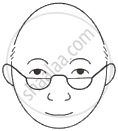
The picture given here shows a person wearing ‘half-moon’ spectacles. What sort of eye-defect do you think he has? Why are these particular spectacles useful to him?
To read a book held at a distance of 25 cm, will she need converging or diverging spectacle lenses?
A person can read a book clearly only if he holds it at an arm's length from him. Name the defect of vision:
- if the person is an old man
- if the person is a young man
Describe the mechanism of focusing the image of a distant object in your eye when you raise your head after reading a book.
A student has difficulty reading the blackboard while sitting in the last row. What could be the defect the child is suffering from? How can it be corrected?
Have a look at the posture of this woman who is reading a book and answer the questions which follow:

What kind of looking glasses she needs?
Rewrite the following table so as to match second and third column with first column.
|
Column I
|
Column II
|
Column III
|
|
(i) Myopia
|
Old age problem
|
Bifocal lens
|
|
(ii) Presbyopia
|
Nearsightedness
|
Concave lens.
|
The near point of the eye of a person is 50 cm. Find the nature and power of the corrective lens required by the person to enable him to see clearly the objects placed at 25 cm from the eye?
Name the following:
The defect of the human eye caused due to the uneven surface of the cornea.
The diagram given below represents the cross-section of the human eye:

(i) Name the parts labeled 1—12.
(ii) What is the function of the part marked ‘10’?
(iii) What would happen if part ‘5’ is damaged or cut?
Which of the following statement is correct?
A student sitting at the back of the classroom cannot read clearly the letters written on the blackboard. What advice will a doctor give to her? Draw ray diagram for the correction of this defect.
Observe the figure and answer the following questions:

- Name the defect of vision represented in the above figure.
- State the reasons for this defect.
- How is it corrected?
- Draw the diagram to show the correction of this defect.
