Advertisements
Advertisements
प्रश्न
A student sitting at the back of the classroom cannot read clearly the letters written on the blackboard. What advice will a doctor give to her? Draw ray diagram for the correction of this defect.
Advertisements
उत्तर
Since, the student sitting at the back of the classroom cannot read clearly the letters written on the blackboard, it means the student is suffering from Myopia. The doctor will suggest her, a concave lens of suitable power which will bring the image back on retina and therefore the defect will be corrected.
The ray diagram for the correction of this defect is as below :
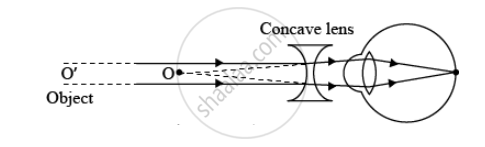
Correction for Myopia
APPEARS IN
संबंधित प्रश्न
What is myopia?
Which defect of vision can be rectified:
by using a convex lens?
What is the scientific name of
long-sightedness?
Name the defect of vision which makes the eye-lens cloudy resulting in blurred vision.
Where is the near point of a person suffering from hypermetropia (or long-sightedness)?
A man can read the number of a distant bus clearly but he finds difficulty in reading a book.
- From which defect of the eye is he suffering?
- What type of spectacle lens should he use to correct the defect?
Explain with the help of labelled ray-diagram, the defect of vision called hypermetropia, and hot it is corrected by a lens.
A short-sighted person has a near point of 15 cm and a far point of 40 cm.
(a) Can he see clearly an object at a distance of:
(i) 5 cm?
(ii) 25 cm?
(iii) 50 cm?
(b) To see clearly an object at infinity, what kind of spectacle lenses does he need?
Which part of the eye is grafted in a needy patient from a donated eye?
Differentiate between members of the following pair with reference to what is asked in bracket.
Myopia and hyperopia (cause of the defect)
Name an old age eye defect. What happens in it?
What is Hypermetropia (far sightedness)?
Given alongside is a diagram depicting a defect of the human eye. Study the same and then answer the questions that follow:
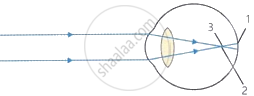
- Identify the defect.
- Name the parts labelled 1, 2 and 3.
- Give two possible reasons for this eye defect.
- Draw a labelled diagram to show how the above mentioned defect is rectified.
Given below is a diagram depicting a defect of the human eye? Study the same and answer the question that follow:

Draw a labeled diagram to show how the above mentioned defect is rectified using the lens named above.
Rewrite the following table so as to match second and third column with first column.
|
Column I
|
Column II
|
Column III
|
|
(i) Myopia
|
Old age problem
|
Bifocal lens
|
|
(ii) Presbyopia
|
Nearsightedness
|
Concave lens.
|
Draw a neat labeled diagram to show how hypermetropia can be rectified.
What type of lens is used to correct Hypermetropia?
With respect to human eye explain:
(i) How is the image formed on the retina?
(ii) How is the amount of light entering the eye-controlled?
(iii) What type of lens is used for the correction of ‘Long sight’ defect?
(iv) With the help of a ray, diagram show the defect of the eye and then its correction after the use of a lens.
Write scientific reason.
Nearsightedness, this defect can be corrected by using spectacles with concave lens.
Myopia may arise due to ____________.
