Advertisements
Advertisements
प्रश्न
What is short-sightedness? State the two causes of short-sightedness (or myopia). With the help of ray diagrams, show:
(i) the eye-defect short-sightedness.
(ii) correction of short-sightedness by using a lens.
Advertisements
उत्तर
Short-sightedness, or near-sightedness, is an eye defect because of which a person cannot see distant objects clearly but has normal near vision. Short-sightedness occurs because of the high converging power of the eye lens (images are formed in front of the retina) and because the eyeball is too long (images are formed in front of the retina).
(i) and (ii) The following diagram illustrates short-sightedness and how concave lenses can correct the defect by diverging the light rays entering the eye to form clear images of distant objects on the retina.

APPEARS IN
संबंधित प्रश्न
A man can read the number of a distant but clearly but he finds difficulty in reading a book.
What type of spectacle lens should he use to correct the defect?
A person suffering from the eye-defect myopia (short-sightedness) can see clearly only up to a distance of 2 metres. What is the nature and power of lens required to rectify this defect?
An eye has a near point distance of 0.75 m. What sort of lens in spectacles would be needed to reduce the near point distance to 0.25 m? Also calculate the power of lens required. Is this eye long-sighted or short-sighted?
An eye has a far point of 2 m. What type of lens in spectacles would be needed to increase the far point to infinity? Also calculate the power of lens required. Is this eye long-sighted or short-sighted?
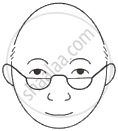
The picture given here shows a person wearing ‘half-moon’ spectacles. What sort of eye-defect do you think he has? Why are these particular spectacles useful to him?
Name the following:
The photosensitive pigment present in the rods of the retina.
Differentiate between members of the following pair with reference to what is asked in the bracket.
Rods and cones (sensitivity).
You do not enjoy watching a movie from a very short distance from the screen in a cinema hall. Why?
State one role of ciliary muscles in the human eye.
What eye defect is hypermetropia? Describe with a ray diagram how this defect of vision can be corrected by using an appropriate lens.
Given below is a diagram depicting a defect of the human eye? Study the same and answer the question that follow:
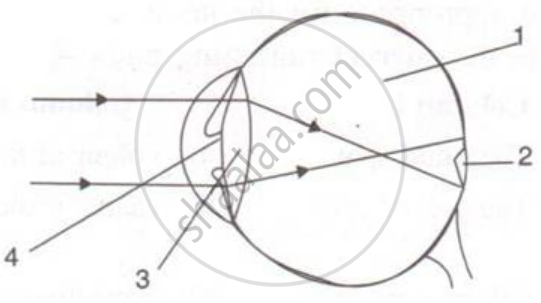
Give two possible reasons for this defect of the eye in human beings.
Given below is a diagram depicting a defect of the human eye? Study the same and answer the question that follow :
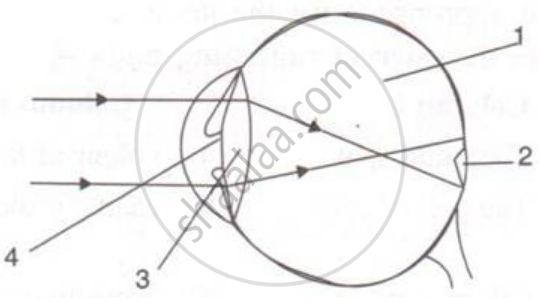
Name the type of lens used to correct this eye defect.
Anuja cannot see the blackboard writing but she can see nearby things.
(a) What is the eye defect she is suffering from?
(b) State the possible reason for her defect.
(c) How is it corrected
Name the common defects of the eye.
Name an old age eye defect. Why is it caused?
Name the following:
The defect of the human eye caused due to the uneven surface of the cornea.
Give Technical Term:
The path which responsible for protecting the eye from sweat.
In Myopia the human eye _______.
A person cannot see distinctly objects kept beyond 2 m. This defect can be corrected by using a lens of power:
A student sitting at the back of the classroom cannot read clearly the letters written on the blackboard. What advice will a doctor give to her? Draw ray diagram for the correction of this defect.
