Advertisements
Advertisements
प्रश्न
Given below is a diagram depicting a defect of the human eye? Study the same and answer the question that follow :
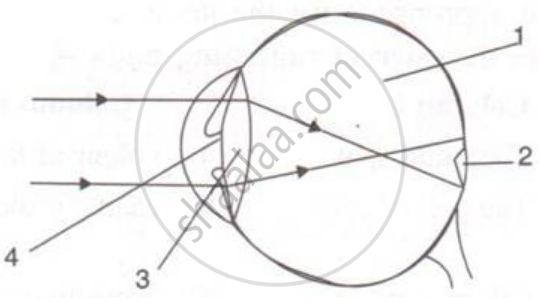
Name the type of lens used to correct this eye defect.
Advertisements
उत्तर
This defect can be corrected by a suitable concave lens.
संबंधित प्रश्न
Name the defect of vision in a person:
whose near point is more than 25 on away.
Name the defect of vision which makes the eye-lens cloudy resulting in blurred vision.
What is the other name of old age hypermetropia?
What is short-sightedness? State the two causes of short-sightedness (or myopia). With the help of ray diagrams, show:
(i) the eye-defect short-sightedness.
(ii) correction of short-sightedness by using a lens.
Though a woman can see the distant object clearly, she cannot see the nearby objects clearly. She is suffering from the defect of vision called:
(a) long-sight
(b) short-sight
(c) hind-sight
(d) mid-sight
List two causes of presbyopia. Draw labelled diagram of a lens used for the correction of this defect of vision.
Explain the Term: Astigmatism
Give Technical Term:
The path which responsible for protecting the eye from sweat.
Mention, if the following statement is True or False
Hypermetropia is a defect of the eye caused due to the eyeball elongation
Match the following:
| Column - I | Column - II |
| 1. Retina | a. Path way of light |
| 2. Pupil | b. Far point comes closer |
| 3. Ciliary muscles | c. near point moves away |
| 4. Myopia | d. Screen of the eye |
| 5. Hypermetropia | e. Power of accommodation |
