Advertisements
Advertisements
Question
What is short-sightedness? State the two causes of short-sightedness (or myopia). With the help of ray diagrams, show:
(i) the eye-defect short-sightedness.
(ii) correction of short-sightedness by using a lens.
Advertisements
Solution
Short-sightedness, or near-sightedness, is an eye defect because of which a person cannot see distant objects clearly but has normal near vision. Short-sightedness occurs because of the high converging power of the eye lens (images are formed in front of the retina) and because the eyeball is too long (images are formed in front of the retina).
(i) and (ii) The following diagram illustrates short-sightedness and how concave lenses can correct the defect by diverging the light rays entering the eye to form clear images of distant objects on the retina.

APPEARS IN
RELATED QUESTIONS
What is myopia?
A person with a myopic eye cannot see objects beyond 1.2 m distinctly. What should be the type of the corrective lens used to restore proper vision?
What is the far point and near point of the human eye with normal vision?
Name the defect of vision in a person:
whose near point is more than 25 on away.
Which defect of vision can be rectified:
by using a concave lens?
A man can read the number of a distant bus clearly but he finds difficulty in reading a book.
- From which defect of the eye is he suffering?
- What type of spectacle lens should he use to correct the defect?
What are the two most common defects of vision (or defects of eye)? How are they corrected?
Name the defect of vision which can be corrected by a diverging lens. Show clearly by a ray diagram how the lens corrects the defect.
Which part of the eye is grafted in a needy patient from a donated eye?
State one role of ciliary muscles in the human eye.
An old man cannot see objects closer than 1 m from the eye clearly. Name the defect of vision he is suffering from. How can it be corrected? Draw ray diagram for the (i) defect of vision and also (ii) for its correction.
The near point of the eye of a person is 50 cm. Find the nature and power of the corrective lens required by the person to enable him to see clearly the objects placed at 25 cm from the eye?
Differentiate between:
Short-sightedness and Long-sightedness.
Choose the Odd One Out:
Which of the following statement is correct?
Observe the figure and answer the following questions:

- Name the defect of vision represented in the above figure.
- State the reasons for this defect.
- How is it corrected?
- Draw the diagram to show the correction of this defect.
Complete the following table by observing the given figures:
| Figure → |  |
 |
| Points ↓ | ||
| (a) Name of the defect | ______ | ______ |
| (b) Position of the image | ______ | ______ |
| (c) Lens used to correct the defect | ______ | ______ |
A teacher drew the diagram of the heart on the blackboard and told the students to copy it in their notebooks. Mahesh couldn't see the diagram clearly as it appeared blurred to him.
- Name the defect of the eye Mahesh is suffering from.
- Where is the image formed in this defect?
- Mahesh consults an eye doctor and is prescribed suitable lenses to correct the defect. Which type of lens do his spectacles have?
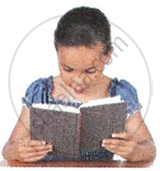
Have a look at the posture of this girl who is reading a book and answer the questions which follow:
 |
- Name the problem she is facing.
- What are the two conditions shown in sections A and B of the eye as applicable to her.
- What kind of reading glasses does she need?
 |
 |
| A | B |
