Advertisements
Advertisements
प्रश्न
To read a book held at a distance of 25 cm, will she need converging or diverging spectacle lenses?
Advertisements
उत्तर
To read a book held at a distance of 25 cm, the person, who is long-sighted, will need converging lenses.
संबंधित प्रश्न
Do you know that the corneal-impairment can be cured by replacing the defective cornea with the cornea of the donated eye? How and why should we organise groups to motivate the community members to donate their eyes after death?
List three common refractive defects of vision. Suggest the way of correcting these defects.
Name the defect of vision which can be corrected by a diverging lens. Show clearly by a ray diagram how the lens corrects the defect.
What is long-sightedness? State the two causes of long-sightedness (or hypermetropia). With the help of ray diagrams, show:
(i) the eye-defect long-sightedness.
(ii) correction of long-sightedness by using a lens.
Though a woman can see the distant object clearly, she cannot see the nearby objects clearly. She is suffering from the defect of vision called:
(a) long-sight
(b) short-sight
(c) hind-sight
(d) mid-sight
The near point of a long-sighted person is 50 cm from the eye.
- Can she see clearly an object at:
- a distance of 20 cm?
- at infinity?
- To read a book held at a distance of 25 cm, will she need converging or diverging spectacle lenses?
Given below is a diagram depicting a defect of the human eye. Study the same and answer the question that follow:

Name the defect shown in the diagram.
State one role of ciliary muscles in the human eye.
When do we consider a student sitting in the class to be myopic? List two causes of this defect. Explain using a ray diagram how this defect of eye can be corrected.
Distinguish between the following pair of words:
Myopia and hypermetropia
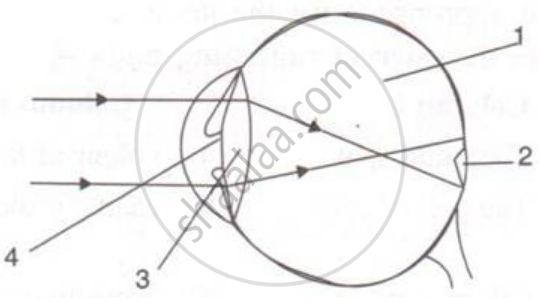
Given below is a diagram depicting a defect of the human eye? Study the same and answer the question that follow:

Name the parts labeled 1 to 4.
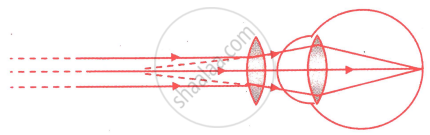
Given below is a diagram depicting a defect of the human eye? Study the same and answer the question that follow :
Name the type of lens used to correct this eye defect.
What type of lens is used to correct Hypermetropia?
Choose the Odd One Out:
Observe the given below the figure, correct it and explain and write about the concept depicted in this figure.
Assertion: Myopia is the defect of vision in which a person cannot see distant objects clearly.
Reason: This due to eye-ball being too short.
Draw ray diagram showing myopic eye.
Observe the following diagram and answer questions following it:

- Identify the defect of vision shown.
- List its two causes.
- Name the type of lens used for the correction of this defect.
Given alongside is a diagram depicting a defect of the human eye. Study the same and answer the questions that follow:
 |
- Name the defect shown in the diagram.
- Give two possible reasons for this defect.
- Name the parts labelled 1 to 4.
- Name the type of lens used to correct this eye defect.
- Draw a labelled diagram to show how the above mentioned defect is rectified using the lens named above.
