Advertisements
Advertisements
प्रश्न
For a specific glass lens f = 0.5 m. This is the only information given to the student. Which type of lens is given to him and what is its power?
पर्याय
power 2 D; convex lens
power 1 D; concave lens
power - 0.5 D; concave lens
power - 0.25 D; convex lens
Advertisements
उत्तर
power 2 D; convex lens
APPEARS IN
संबंधित प्रश्न
"A convex lens can form a magnified erect as well as magnified inverted image of an object placed in front of it." Draw ray diagram to justify this statement stating the position of the object with respect to the lens in each case.
Describe with the help of a ray diagram the nature, size and position of the image formed when an object is placed at infinity (considerable distance) in front of a convex lens. State three characteristics of the image so formed.
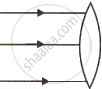
What type of lens is shown in the diagram on the right? What will happen to the parallel rays of light? Show by completing the ray diagram.
How could you find the focal length of a convex lens rapidly but approximately?
Three convex lenses are available having focal lengths of 4 cm, 40 cm and 4 m respectively. Which one would you choose as a magnifying glass and why?
A convex lens of focal length 8 cm forms a real image of the same size as the object. The distance between object and its image will be:
An object 4 cm high is placed at a distance of 10 cm from a convex lens of focal length 20 cm. Find the position, nature and size of the image.
Calculate the focal length of a convex lens which produces a virtual image at a distance of 50 cm of an object placed 20 cm in front of it.
- An object 3 cm high is placed 24 cm away from a convex lens of focal length 8 cm. Find by calculations, the position, height and nature of the image.
- If the object is moved to a point only 3 cm away from the lens, what is the new position, height and nature of the image?
- Which of the above two cases illustrates the working of a magnifying glass?
A student did an experiment with a convex lens. He put an object at different distances 25 cm, 30 cm, 40 cm, 60 cm and 120 cm from the lens. In each case he measured the distance of the image from the lens. His results were 100 cm, 24 cm, 60 cm, 30 cm and 40 cm, respectively. Unfortunately his results are written in wrong order.
- Rewrite the image distances in the correct order.
- What would be the image distance if the object distance was 90 cm?
- Which of the object distances gives the biggest image?
- What is the focal length of this lens?
A convex lens of focal length 10 cm is placed in contact with a concave lens of focal length 20 cm. The focal length of this combination of lenses will be:
(a) +10 cm
(b) +20 cm
(c) −10 cm
(d) −20 cm
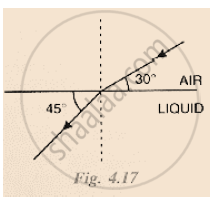
The diagram alongside shows the refraction of a ray of light from sir to a liquid.
(a) write the values of (i) angle of incidence, (ii) angle of refraction.
(b) use snell’s law to find the refractive index of liquid with respect to air.
A light ray does not bend at the boundary in passing from one medium to the other medium if the angle of incident is:
A convex lens is placed in water. Its focal length will ______.
In the following cases, where must an object be placed in front of a convex lens so that the image formed is of the same size as the object?
State the position of object, position of image, nature of image when: Convex lens is used as objective lens of astronomical telescope.
Write the three characteristics of the image formed by a convex lens of focal length 20 cm for the object at distance (i) 10 cm, (ii) 30 cm, (iii) 40 cm, (iv) 60 cm from the lens.
Write the name.
The lens used in simple microscope.
Distinguish between:
Concave lens and Convex lens
