Advertisements
Advertisements
Question
For a specific glass lens f = 0.5 m. This is the only information given to the student. Which type of lens is given to him and what is its power?
Options
power 2 D; convex lens
power 1 D; concave lens
power - 0.5 D; concave lens
power - 0.25 D; convex lens
Advertisements
Solution
power 2 D; convex lens
APPEARS IN
RELATED QUESTIONS
If you focus the image of a distant object, whose shape is given below, on a screen using a convex lens, the shape of the image of this object on the screen would be:
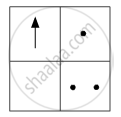
(a)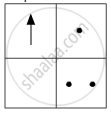
(b)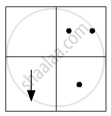
(c)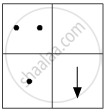
(d)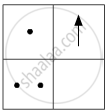
Study the given ray diagrams and select the correct statement from the following:
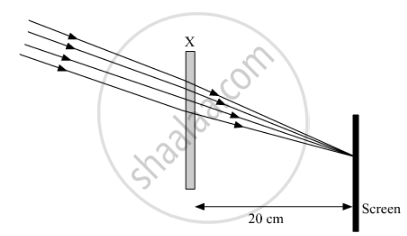
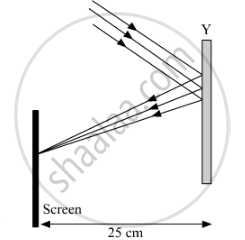
(A) Device X is a concave mirror and device Y is a convex lens, whose focal lengths are 20 cm and 25 cm respectively.
(B) Device X is a convex lens and device Y is a concave mirror, whose focal lengths are 10 cm and 25 cm respectively.
(C) Device X is a concave lens and device Y is a convex mirror, whose focal lengths are 20 cm and 25 cm respectively.
(D) Device X is a convex lens and device Y is a concave mirror, whose focal lengths are 20 cm and 25 cm respectively.
A beam of light travelling in a rectangular glass slab emerges into air. Draw a ray-diagram indicating the change in its path.
Draw a labelled ray diagram to show how a ray of light is refracted when it passes:
from an optically denser medium into air.
Where should an object be placed in order to use a convex lens as a magnifying glass?
State whether the convex lens has a real focus or a virtual focus.
An object is placed f and 2f of a convex lens. Which of the following statements correctly describes its image?
(a) real, larger than the object
(b) erect, smaller than the object
(c) inverted, same size as object
(d) virtual, larger than the object
Describe the nature of image formed when an object is placed at a distance of 30 cm from a convex lens of focal length 15 cm.
Find the nature, position and magnification of the images formed by a convex lens of focal length 0.20 m if the object is placed at a distance of:
0.25 m
The given below figure shows an object OA and its image IB formed by a lens.
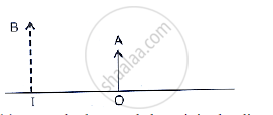
Complete the following table:
| Type of lens | Position of object | Nature of image | Size of image |
| Convex | Between optical centre and focus | ||
| Convex | At focus | ||
| Concave | At infinity | ||
| Concave | At any distance |
Observe the following figure and answer the questions.

a) Which optical instrument shows arrangement of lenses as shown in the figure?
b) Write in brief the working of this optical instrument.
c) How can we get different magnifications in this optical instrument?
d) Draw the figure again and labelled it properly
A lens always forms an image between the object and the lens.
A lens always forms an image between the object and the lens.
What happens to the image formed by a convex lens if its lower part is blackened?
A candle is placed between f and 2f a convex lens. Draw a ray diagram showing the position of the image.
Can one bum a piece of paper in daylight by just using a convex lens instead of a match or any direct flame? Support your answer with the help of an appropriate ray diagram.
Object at 2F1 of a convex lens : Image at 2F2 : : Object at F1 : _______
Which of the following statements is true?
Distinguish between:
Concave lens and Convex Lens
Distinguish between:
Concave lens and Convex lens
