Advertisements
Advertisements
Question
Observe the following figure and complete the table:

| Points | Answer |
| (i) Position of the object | |
| (ii) Position of the image | |
| (iii) Size of the image | |
| (iv) Nature of the image |
Advertisements
Solution
| Points | Answer |
| (i) Position of the object | between F1 and optical center |
| (ii) Position of the image | same side to the object (between 2F1 and F1) |
| (iii) Size of the image | Magnified |
| (iv) Nature of the image | Virtual and erect |
APPEARS IN
RELATED QUESTIONS
To determine the approximate focal length of the given convex lens by focussing a distant object (say, a sign board), you try to focus the image of the object on a screen. The image you obtain on the screen is always
(a) erect and laterally inverted
(b) erect and diminished
(c) inverted and diminished
(d) virtual, inverted and diminished
"A lens can form a magnified erect image as well as magnified inverted image of an object placed in front of it." State the nature of this lens and draw ray diagrams to justify the above statement. Mark the positions of O, F and 2F in the diagram.
Draw a ray diagram to show the formation of the image of an object be placed so that a real and inverted image of the same size as the object is obtained using a convex lens
For what position of an object a real, diminished image is formed by a convex lens?
State whether the convex lens has a real focus or a virtual focus.
A convex lens of focal length 8 cm forms a real image of the same size as the object. The distance between object and its image will be:
An object 50 cm tall is placed on the principal axis of a convex lens. Its 20 cm tall image is formed on the screen placed at a distance of 10 cm from the lens. Calculate the focal length of the lens.
A beam of parallel light rays is incident through the holes on one side of a box and emerges out through the holes on its opposite side as shown in the diagram below:
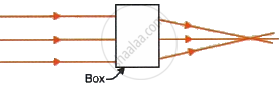
Which of the following could be inside the box?
The focal lengths of four convex lenses P, Q, R and S are 20 cm, 15 cm, 5 cm and 10 cm, respectively. The lens having the greatest power is:
The focal length of a thin convex lens is ______ than that of a thick convex lens.
Study the diagram given below.

- Name the lens LL’.
- What are the points O and O’ called?
- Complete the diagram to form the image of the object AB.
- State the three characteristics of the image.
- Name a device in which this action of lens is used.
State two applications of a convex lens.
While determining the focal length of a convex lens, you try to focus the image of a distant object formed by the lens on the screen. The image formed on the screen, as compared to the object, should be
(A) erect and highly diminished
(B) erect and enlarged
(C) inverted and enlarged
(D) inverted and highly diminished
Out of the five incident rays shown in the figure find the three rays that are obeying the laws of refraction and may be used for locating the position of image formed by a convex lens:
(A) 1, 2 and 3
(B) 2, 3 and 4
(C) 3, 4 and 5
(D) 1, 2 and 4
(a) What type of a lens can be used as a magnifying glass?
(b) Show by a ray diagram the formation of a real image by simple magnifying lens.
If an object is placed in front of a convex lens beyond 2F1, then what will be the position, relative size, and nature of an image which is formed? Explain with a ray diagram.
State the position of object, position of image, nature of image when: Convex lens is used as an erecting lens in terrestrial telescope.
State the nature and position of the object on the principal axis to obtain a virtual and magnified image.
Write scientific reason.
Adults need bifocal lens spectacle.
- In which type of microscope do you find the lens arrangement as shown in the following diagram?

- Write about the working and the use of this microscope.
