Advertisements
Advertisements
प्रश्न
Observe the following figure and complete the table:

| Points | Answer |
| (i) Position of the object | |
| (ii) Position of the image | |
| (iii) Size of the image | |
| (iv) Nature of the image |
Advertisements
उत्तर
| Points | Answer |
| (i) Position of the object | between F1 and optical center |
| (ii) Position of the image | same side to the object (between 2F1 and F1) |
| (iii) Size of the image | Magnified |
| (iv) Nature of the image | Virtual and erect |
APPEARS IN
संबंधित प्रश्न
(a) Draw a ray diagram to show the formation of an image by a convex lens when an object is placed in front of the lens between its optical centre and principal focus.
(b) In the above ray diagram, mark the object distance (u) and the image distance (v) with their proper signs (+ve or –ve as per the new Cartesian sign convention) and state how these distances are related to the focal length (f) of the convex lens in this case.
(c) Find the power of a convex lens which forms a real and inverted image of magnification –1 of an object placed at a distance of 20 cm from its optical centre.
A student places a candle flame at a distance of about 60 cm from a convex lens of focal length 10 cm and focuses the image of the flame on a screen. After that he gradually moves the flame towards the lens and each time focuses the image on the screen.
(a) In which direction-toward or away from the lens, does he move the screen to focus the image?
(b) How does the size of the image change?
(c) How does the intensity of the image change as the flame moves towards the lens?
(d) Approximately for what distance between the flame and the lens, the image formed on the screen is inverted and of the same size?
Describe with the help of a ray-diagram, the formation of image of a finite object placed in front of convex lens between f and 2f. Give two characteristics of the image so formed.
In order to obtain a real image twice the size of the object with a convex lens of focal length 15 cm, the object distance should be:
(a) more than 5 cm but less than 10 cm
(b) more than 10 cm but less than 15 cm
(c) more than 15 cm but less than 30 cm
(d) more than 30 cm but less than 60 cm
A convex lens of focal length 6 cm is held 4 cm from a newspaper which has print 0.5 cm high. By calculation, determine the size and nature of the image produced.
A student did an experiment with a convex lens. He put an object at different distances 25 cm, 30 cm, 40 cm, 60 cm and 120 cm from the lens. In each case he measured the distance of the image from the lens. His results were 100 cm, 24 cm, 60 cm, 30 cm and 40 cm, respectively. Unfortunately his results are written in wrong order.
What is the focal length of this lens?
How would a pencil look like if you saw it through a convex lens? (Assume the pencil is close to the lens). Is the image real or virtual?
A beam of parallel light rays is incident through the holes on one side of a box and emerges out through the holes on its opposite side as shown in the diagram below:
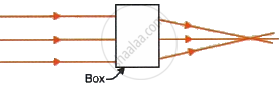
Which of the following could be inside the box?
What would be the diameter of the image of the flower on the film?
Which part causes the greatest convergence?
Study the diagram given below.

- Name the lens LL’.
- What are the points O and O’ called?
- Complete the diagram to form the image of the object AB.
- State the three characteristics of the image.
- Name a device in which this action of lens is used.
A converging lens forms the image of an object placed in front of it, beyond 2F2 of the lens. Draw a ray diagram to show the formation of the image.
A lens forms an upright and magnified image of an object. Name the lens.
Analyse the following observation table showing variation of image-distance (v) with object-distance (u) in case of a convex lens and answer the questions that follow without doing any calculations:
| S. No. | Object-Distance u (cm) |
Image-Distance v (cm) |
| 1 | –60 | +12 |
| 2 | –30 | +15 |
| 3 | –20 | +20 |
| 4 | –15 | +30 |
| 5 | –12 | +60 |
| 6 | –9 | +90 |
(a) What is the focal length of the convex lens? State reason for your answer.
(b) For what object-distance (u) is the corresponding image-distance (v) not correct? How did you arrive at this conclusion?
(c) Choose an appropriate scale to draw a ray diagram for the observation at S. No. 4 and find the approximate value of magnification.
State the nature and position of the object on the principal axis to obtain a real image of the same size
Draw a diagram to show the convergent action of a convex lens by treating it as a combination of glass block and two triangular glass prisms, with the aid of two parallel incident rays.
Write the name.
The lens used in simple microscope.
A beam of light is incident through the holes on side A and emerges out of the holes on the other face of the box as show in the figure. Which of the following could be inside the box?

Distinguish between:
Concave lens and Convex Lens
