Advertisements
Advertisements
प्रश्न
Observe the following figure and complete the table:

| Points | Answer |
| (i) Position of the object | |
| (ii) Position of the image | |
| (iii) Size of the image | |
| (iv) Nature of the image |
Advertisements
उत्तर
| Points | Answer |
| (i) Position of the object | between F1 and optical center |
| (ii) Position of the image | same side to the object (between 2F1 and F1) |
| (iii) Size of the image | Magnified |
| (iv) Nature of the image | Virtual and erect |
APPEARS IN
संबंधित प्रश्न
An object of height 4.0 cm is placed at a distance of 30 cm from the optical centre 'O' of a convex lens of focal length 20 cm. Draw a ray diagram to find the position and size of the image formed. Mark optical centre 'O' and principal focus 'F' on the diagram. Also find the approximate ratio of size of the image to the size of the object.
Draw a labelled ray diagram to show how a ray of light passes through a parallel-sided glass block if it hits the glass block at an angle other than 90° (that is, obliquely to the glass block).
For what position of an object a real, diminished image is formed by a convex lens?
How could you find the focal length of a convex lens rapidly but approximately?
A convex lens of focal length 15 cm produces a magnification of +4. The object is placed:
(a) at a distance of 15 cm
(b) between 15 cm and 30 cm
(c) at less than 15 cm
(d) beyond 30 cm
A student did an experiment with a convex lens. He put an object at different distances 25 cm, 30 cm, 40 cm, 60 cm and 120 cm from the lens. In each case he measured the distance of the image from the lens. His results were 100 cm, 24 cm, 60 cm, 30 cm and 40 cm, respectively. Unfortunately his results are written in wrong order.
What is the focal length of this lens?
An object 50 cm tall is placed on the principal axis of a convex lens. Its 20 cm tall image is formed on the screen placed at a distance of 10 cm from the lens. Calculate the focal length of the lens.
What kind of lens can form:
an erect magnified image?
What would be the diameter of the image of the flower on the film?
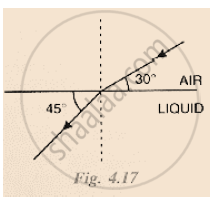
The diagram alongside shows the refraction of a ray of light from sir to a liquid.
(a) write the values of (i) angle of incidence, (ii) angle of refraction.
(b) use snell’s law to find the refractive index of liquid with respect to air.
A lens forms an inverted image of an object. Name the kind of lens.
In the following cases, where must an object be placed in front of a convex lens so that the image formed is at infinity?
Analyse the following observation table showing variation of image-distance (v) with object-distance (u) in case of a convex lens and answer the questions that follow without doing any calculations:
| S. No. | Object-Distance u (cm) |
Image-Distance v (cm) |
| 1 | –60 | +12 |
| 2 | –30 | +15 |
| 3 | –20 | +20 |
| 4 | –15 | +30 |
| 5 | –12 | +60 |
| 6 | –9 | +90 |
(a) What is the focal length of the convex lens? State reason for your answer.
(b) For what object-distance (u) is the corresponding image-distance (v) not correct? How did you arrive at this conclusion?
(c) Choose an appropriate scale to draw a ray diagram for the observation at S. No. 4 and find the approximate value of magnification.
When you focus the image of a distant flag, whose shape is given below, on a screen using a convex lens, the shape of the image as it appears on the screen is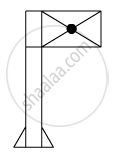
(A)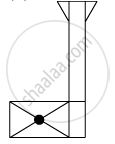
(B)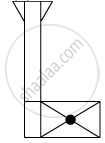
(C)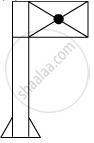
(D)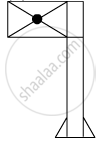
Out of the two lenses one concave and the other convex state which is a convergent or a divergent type of a lens. Give a reason for your answer.
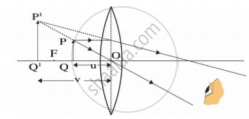 : Object near the lens : : ______ :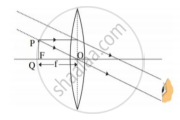
Find the odd one out and give its explanation.
Write the name.
The lens used in simple microscope.
Distinguish between:
Concave lens and Convex lens
