Advertisements
Advertisements
प्रश्न
विकल्प
40 cm
25 cm
`1/40` cm.
`1/25` cm
Advertisements
उत्तर
The power of a convex lens is 2.5 dioptres. Its focal length is 40 cm.
APPEARS IN
संबंधित प्रश्न
Where should an object be placed so that a real and inverted image of the same size as the object is obtained using a convex lens?
A ray of light travelling in water emerges into air. Draw a ray-diagram indicating the change in its path.
A 1 cm high object is placed at a distance of 2f from a convex lens. What is the height of the image formed?
An object is placed f and 2f of a convex lens. Which of the following statements correctly describes its image?
(a) real, larger than the object
(b) erect, smaller than the object
(c) inverted, same size as object
(d) virtual, larger than the object
In order to obtain a real image twice the size of the object with a convex lens of focal length 15 cm, the object distance should be:
(a) more than 5 cm but less than 10 cm
(b) more than 10 cm but less than 15 cm
(c) more than 15 cm but less than 30 cm
(d) more than 30 cm but less than 60 cm
Find the nature, position and magnification of the images formed by a convex lens of focal length 0.20 m if the object is placed at a distance of:
0.15 m
What type of images can a convex lens make?
A beam of parallel light rays is incident through the holes on one side of a box and emerges out through the holes on its opposite side as shown in the diagram below:
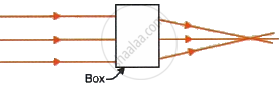
Which of the following could be inside the box?
Which part causes the greatest convergence?
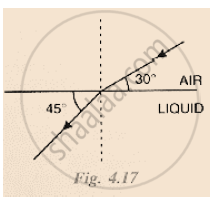
The diagram alongside shows the refraction of a ray of light from sir to a liquid.
(a) write the values of (i) angle of incidence, (ii) angle of refraction.
(b) use snell’s law to find the refractive index of liquid with respect to air.
A parallel oblique beam of light falls on a convex lens. Draw a diagram to show the refraction of light through the lens.
The focal length of a thin convex lens is ______ than that of a thick convex lens.
In the following cases, where must an object be placed in front of a convex lens so that the image formed is upright and enlarged?
A teacher sets up the stand carrying a convex lens of focal length 15 cm at 42.7 cm mark on the optical bench. He asks four students A, B, C and D to suggest the position of screen on the optical bench so that a distinct image of a distant tree is obtained almost immediately on it. The positions suggested by the students were as
A. 12.7 cm
B. 29.7 cm
C. 57.7 cm
D. 72.7 cm
The correct position of the screen was suggested by
(a) A
(b) B
(c) C
(d) D
While determining the focal length of a convex lens, you try to focus the image of a distant object formed by the lens on the screen. The image formed on the screen, as compared to the object, should be
(A) erect and highly diminished
(B) erect and enlarged
(C) inverted and enlarged
(D) inverted and highly diminished
A student focussed the image of a distant object using a device ‘X’ on a white screen ‘S’ as shown in the figure. If the distance of the screen from the device is 40 cm, select the correct statement about the device.
(A) The device X is a convex lens of focal length 20 cm.
(B) The device X is a concave mirror of focal length 40 cm.
(C) The device X is a convex mirror of radius of curvature 40 cm.
(D) The device X is a convex lens of focal length 40 cm.
The focal length of a lens is positive. In this case, state the kind of lens.
A convex lens forms an inverted image of size same as that of the object which is placed at a distance 60 cm in front of the lens. Find: The position of image
Out of the two lenses one concave and the other convex state which is a convergent or a divergent type of a lens. Give a reason for your answer.
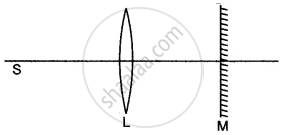
In the figure given below L is a convex lens, M is a plane mirror and S is a point source of light. Rays of light from the source S return to their point of origin. Complete the ray diagram to show this. What is the point S called?