Advertisements
Advertisements
Question
Options
40 cm
25 cm
`1/40` cm.
`1/25` cm
Advertisements
Solution
The power of a convex lens is 2.5 dioptres. Its focal length is 40 cm.
APPEARS IN
RELATED QUESTIONS
(a) Draw a ray diagram to show the formation of an image by a convex lens when an object is placed in front of the lens between its optical centre and principal focus.
(b) In the above ray diagram, mark the object distance (u) and the image distance (v) with their proper signs (+ve or –ve as per the new Cartesian sign convention) and state how these distances are related to the focal length (f) of the convex lens in this case.
(c) Find the power of a convex lens which forms a real and inverted image of magnification –1 of an object placed at a distance of 20 cm from its optical centre.
When a ray of light enters from one medium to another having different optical densities it bends. Why does this phenomenon occur?
An object is placed at a distance of 12 cm from a convex lens of focal length 8 cm. Find :
1) the position of the image
2) nature of the image
Describe with the help of a ray-diagram, the formation of image of a finite object placed in front of convex lens between f and 2f. Give two characteristics of the image so formed.
An object is placed f and 2f of a convex lens. Which of the following statements correctly describes its image?
(a) real, larger than the object
(b) erect, smaller than the object
(c) inverted, same size as object
(d) virtual, larger than the object
A convex lens of focal length 0.10 m is used to form a magnified image of an object of height 5 mm placed at a distance of 0.08 m from the lens. Calculate the position, nature and size of the image.
A student did an experiment with a convex lens. He put an object at different distances 25 cm, 30 cm, 40 cm, 60 cm and 120 cm from the lens. In each case he measured the distance of the image from the lens. His results were 100 cm, 24 cm, 60 cm, 30 cm and 40 cm, respectively. Unfortunately his results are written in wrong order.
What is the focal length of this lens?
Which type of lenses are:
thicker in the middle than at the edges?
What type of lens is used to correct
hypermetropia
In a certain murder investigation, it was important to discover whether the victim was long-sighted or short-sighted. How could a detective decide by examining his spectacles?
In figure , name the ray which represents the correct path of light while emerging out through
a glass block.
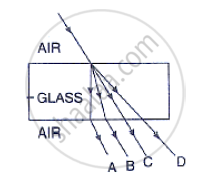
A light ray does not bend at the boundary in passing from one medium to the other medium if the angle of incident is:
The focal length of a thin convex lens is ______ than that of a thick convex lens.
List four properties of the image formed by a convex mirror.
The image obtained while finding the focal length of convex lens is ....................
Yesh find out F1 and F2 of symmetric convex lens experimentally then which conclusion is true.
An object 4.0 cm in size, is placed 25.0 cm in front of a concave mirror of focal length 15.0 cm.
- At what distance from the mirror should a screen be placed in order to obtain a sharp image?
- Find the size of the image.
- Draw a ray diagram to show the formation of the image in this case.
State the nature and position of the object on the principal axis to obtain a real image of the same size
Draw a ray diagram to illustrate the determination of the focal length of a convex lens using an auxiliary plane mirror.
Differentiate convex lens and concave lens.
