Advertisements
Advertisements
Question
Differentiate convex lens and concave lens.
Advertisements
Solution
| Convex Lens | Concave Lens |
| 1. The lens which is thicker at the centre than at the edges. | 1. The lens is thinner at the centre than at the edges. |
| 2. Abeam of light passing through it, is converged to a point. | 2. A beam of light passing through it is diverged or spread out. |
| 3. It is called a converging lens. | 3. It is called a diverging lens. |
APPEARS IN
RELATED QUESTIONS
An object 5 cm is placed at a distance of 20 cm in front of a convex mirror of radius of curvature 30 cm. Find the position, nature and size of the image.
If an object is at a considerable distance (or infinity) in front of a convex lens, where is the image formed?
Parallel rays of light are refracted by a convex lens to a point called the ______.
What is the position of image when an object is placed at a distance of 10 cm from a convex lens of focal length 10 cm?
What kind of lens can form:
an erect magnified image?
A convex lens has a divergent action and a concave lens has a convergent action.
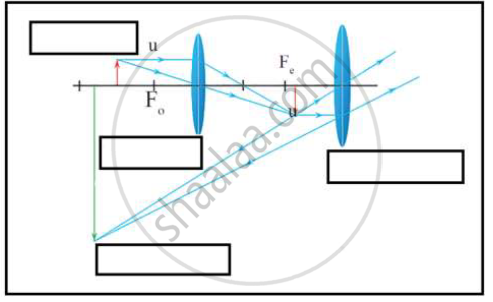
i. Which type of microscope has the arrangement of lenses shown in the adjoining figure?
ii. Label the figure correctly.
iii. Write the working of this microscope.
iv. Where does this microscope used?
v. Suggest a way to increase the efficiency of this microscope.
State the position of object, position of image, nature of image when: Convex lens is used as an erecting lens in terrestrial telescope.
In the figure given below L is a convex lens, M is a plane mirror and S is a point source of light. Rays of light from the source S return to their point of origin. Complete the ray diagram to show this. What is the point S called?
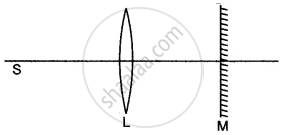
How will you determine the focal length of a convex lens by the plane mirror method?
